At a glance. Check airflow requirements, fan performance at working pressure, cooling-pad resistance and installation details before specifying poultry exhaust fans.
Ventilation is the single biggest factor in flock health, and it is also where undersized systems quietly kill your heaviest birds in a heat wave. Sizing exhaust fans is not guesswork - here are the two methods we use, with real equipment numbers.
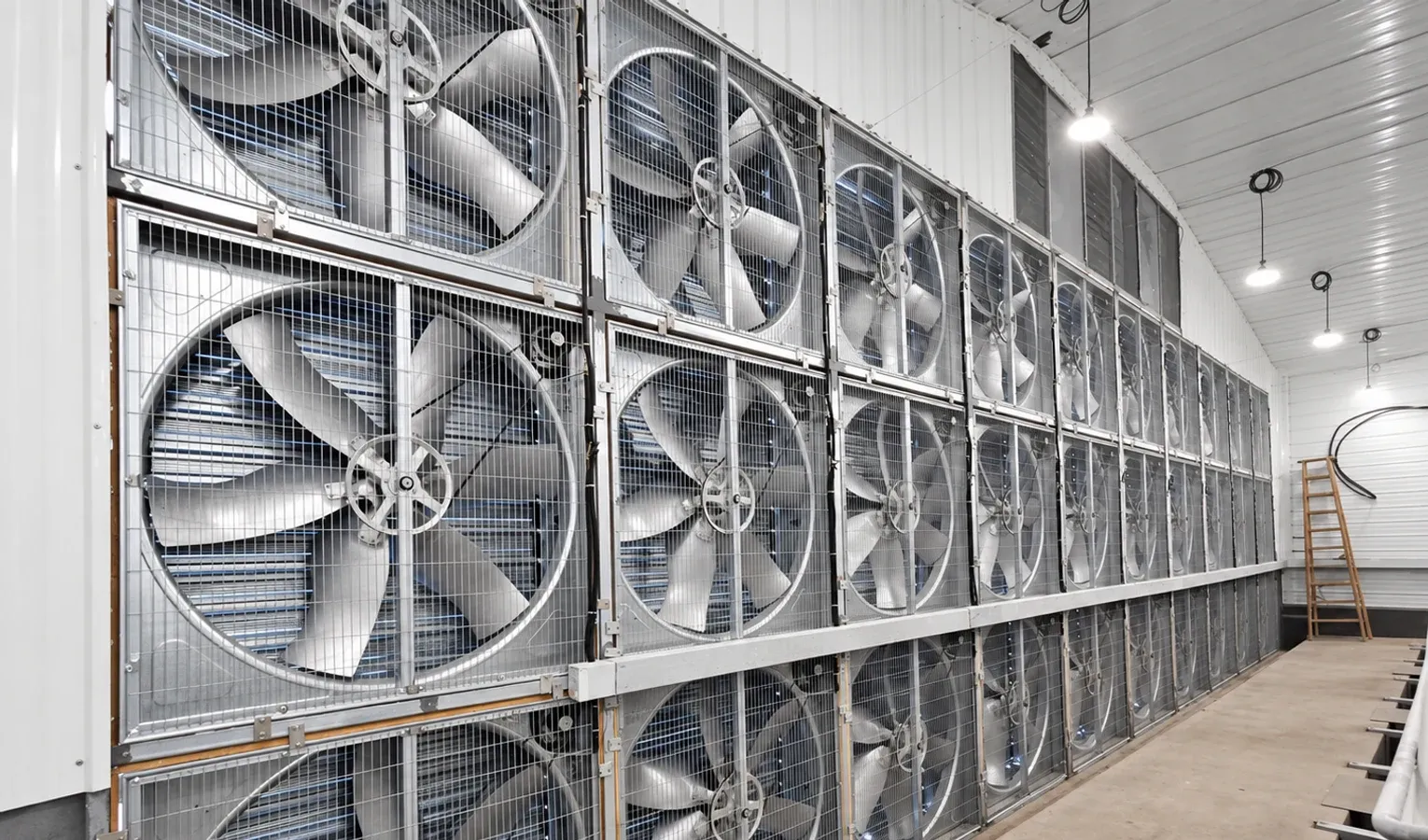
Method 1 - the quick rule
For a fast estimate, plan one exhaust fan per 2,000 birds. A 16,000-bird house needs about 8 fans. It is rough, but it gets you in the right range for budgeting.
Method 2 - the engineering formula (tunnel ventilation)
For a proper design, size fans to move air through the house at the target tunnel velocity. The formula:
- Number of fans = (House width x height) x 3.5 x 3600 / 38,000
Where width x height is the end-wall cross-section in metres, 3.5 m/s is the target air velocity through the house, 3600 converts to per-hour, and 38,000 m3/h is the airflow of one exhaust fan. Example: a house 12 m wide x 3 m high = 36 m2 cross-section, so (36 x 3.5 x 3600) / 38,000 = about 12 fans for full tunnel ventilation.
Cooling pads
Pair the fans with evaporative cooling pads on the air-inlet gable. Size the pad area so air passes through it at 1.5-2 m/s; as a working figure, cooling pad costs about $20 per square metre, and an exhaust fan about $180 each. Together, fans and pads hold the house in the 13-26C comfort band even in a hot climate.
Why it matters in money
Above 26C, feed conversion drops and stress rises; above ~43C, birds start dying - and it is always the biggest, most valuable birds that go first. Ventilation is a small share of total farm cost but protects the entire flock, so it is the last place to economize. It is also, on many "cheap" quotes, left out entirely - so confirm fans and pads are line items before you compare prices.
Send us your house length, width and height and your climate, and we will calculate the exact fan count, cooling-pad area and an itemized ventilation quote.
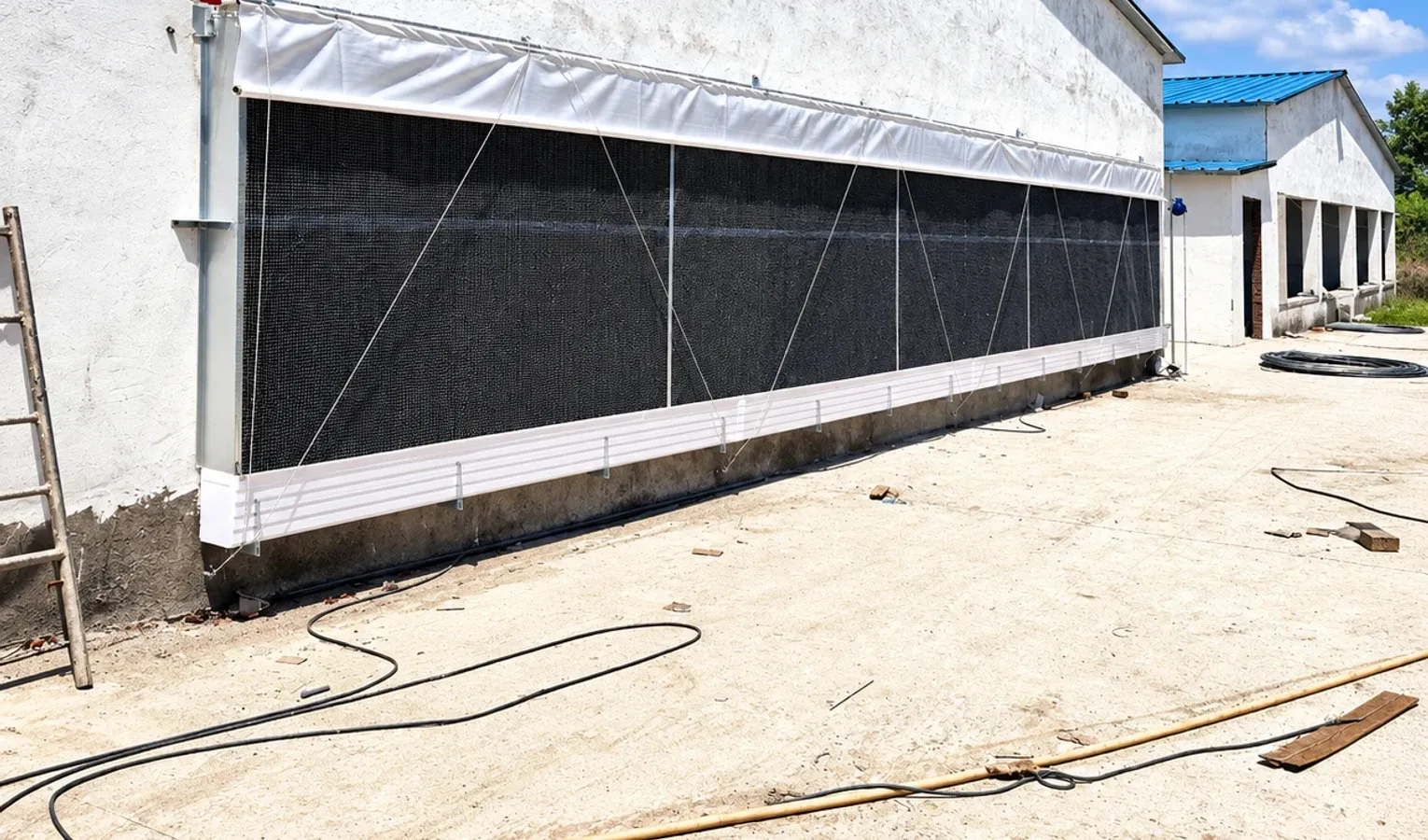
Confirm the duty point behind the fan rating
Fan output changes with operating resistance. A free-air figure should not be treated as the delivered airflow in an installed poultry house. Ask for performance data at the pressure used in the design and record that assumption with the fan schedule. The designer should consider the complete air path, including the planned inlets, cooling equipment and building conditions.
Use calculations as a design input
A preliminary airflow calculation can help organise a discussion, but it is not a complete ventilation design. The required operation changes with the flock stage and outside conditions. Ask how minimum, transitional and hot-weather operation will be handled. Avoid selecting a fan count from a single volume or velocity calculation without reviewing the rest of the system.
Check installation details
Confirm the mounting openings, shutter clearance, electrical supply and access for maintenance. Fans must be installed according to their instructions and the approved building details. Unplanned restrictions and air leakage can affect the intended air movement. Coordinate the fan and inlet work with the contractor so the completed envelope matches the design assumptions.
Verify the whole house at commissioning
The commissioning plan should cover the fan stages, inlets, controls, alarms and agreed backup response. Measurements should be taken using appropriate instruments and documented locations. Compare the observed operation with the design assumptions and investigate differences. A controller displaying a plausible value does not prove that every area of the building has the intended conditions.
Retain a service baseline
Keep the fan models, performance curves, controller settings and commissioning record together. Record cleaning and maintenance work so later changes can be interpreted. If a house problem develops, compare equipment condition and operation with that baseline before adding more fans. Use a qualified ventilation designer and the flock's current management guidance for the final assessment.
Visual checklist
Related reading
Poultry Cooling Pads: Sizing and Operating Checks
Poultry House Static Pressure and Air Inlet Operation
Further reading
UGA poultry ventilation resources
Check operating targets against bird age, local climate, measured house conditions and the equipment specifications. A general design example does not replace a house-specific ventilation assessment.