H Type Automatic Layer Battery Cage System
Specifications
- Tiers3 to 8 tiers
- FeedingAutomatic travelling hopper, over 95% distribution evenness
- DrinkingCone-valve nipple line, 3 mm square water pipe, 0.18 to 0.22 MPa
- MaterialHot-dip galvanized low-carbon steel (Q235)
- Cage cell45 x 40 cm
- StructureH-type, vertically stacked tiers
- Service life15 to 20 years
- CertificationISO 9001, SONCAP, PVOC
- Wire diameter1.56 mm hot-dip galvanized
- Egg collectionCentral automatic belt, 0.2 to 1% breakage
- Manure removalIndependent belt on every tier, dries manure to about 30% moisture
- Floor space per bird400 to 450 cm²
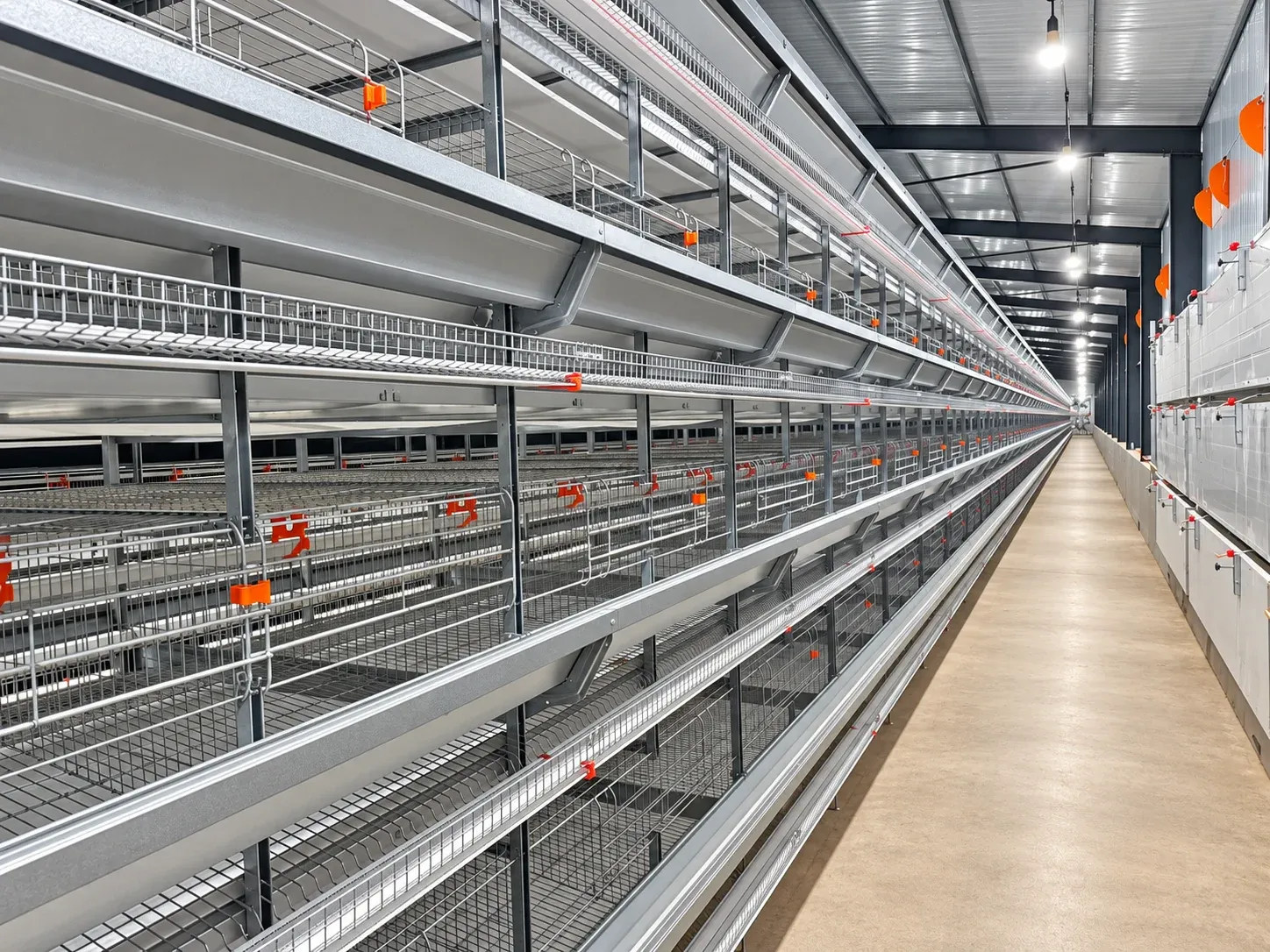
Stacking is the whole idea behind an H-type layer cage: instead of stepping tiers outward like an A-frame, the cage rows sit directly on top of one another, so a house of the same footprint can carry two to five times the birds. That density is why large commercial layer farms almost always specify H-type, and why the system is engineered very differently from an economy A-type cage.
What "H-type" actually means for stacking density
In an H-type frame each tier is vertically aligned over the one below, separated by a manure belt rather than an open drop zone. Because tiers do not fan outward, you can go 3, 4, 5, 6, or up to 8 tiers high in the same aisle width. A house that holds around 16,000 birds in A-type layout will commonly hold 30,000 or more in H-type on the same slab. The trade-off is building height: stacked houses want an eave of 4 m or more, and the taller you go the more you depend on mechanical feeding, water and egg belts because nothing above chest height can be reached by hand.
The independent manure belt on every tier
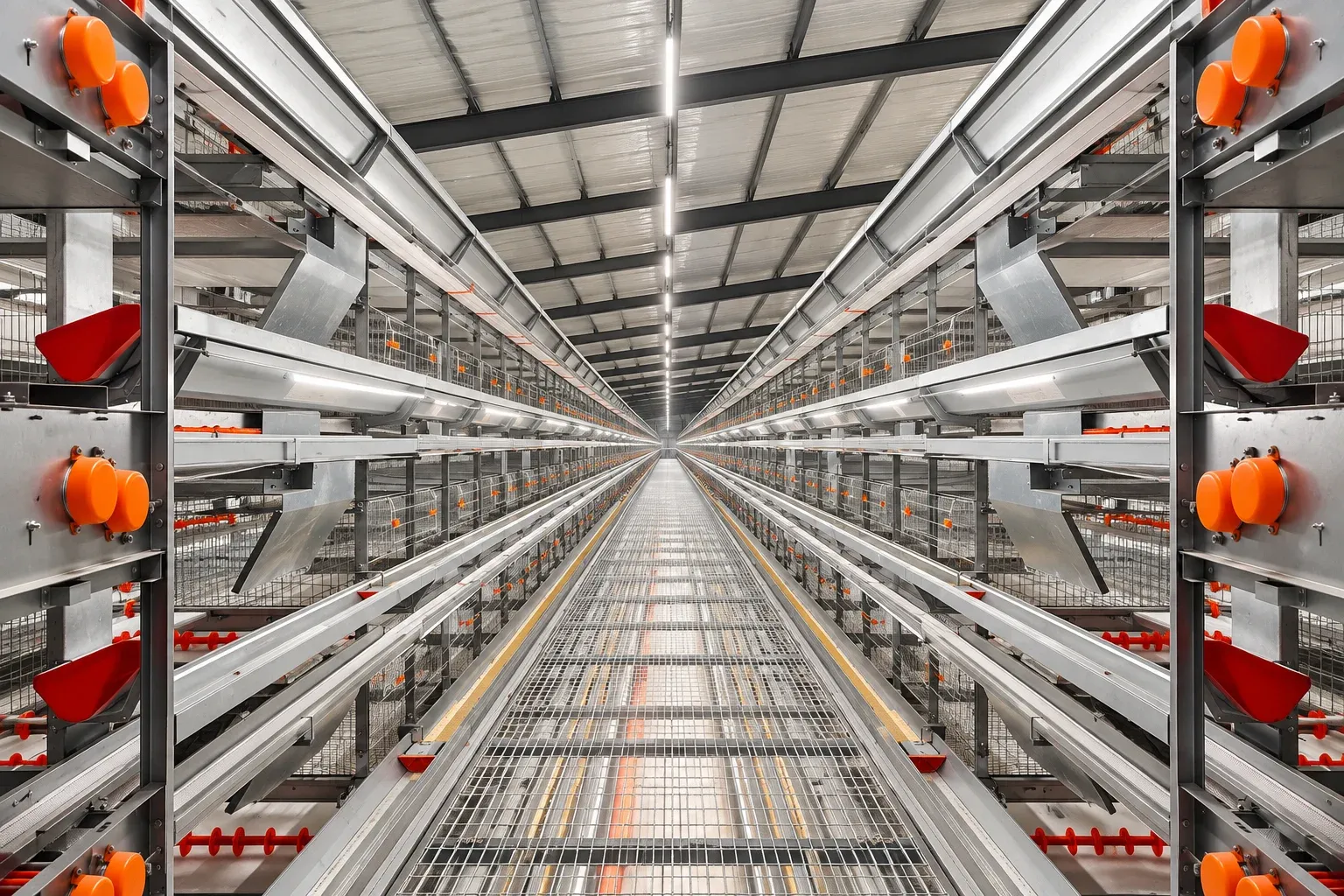
This is the feature that separates a real H-type system from a cheap stack of cages. Every tier gets its own PP manure belt running the length of the row, so droppings never fall onto the birds below. Belts run on a schedule — daily, or every 2 to 4 days — and belt airflow dries the manure down to roughly 30% moisture from a fresh 60%, which keeps in-house ammonia under about 25 ppm. A cross conveyor at the row end carries everything out to a gable or trailer. In a real A-type quote the manure system alone runs close to 28% of the equipment cost, so on an 8-tier H-type — with a belt on every level — this is a large part of what you are paying for and worth inspecting closely.
H-Type Layer Cage Planning
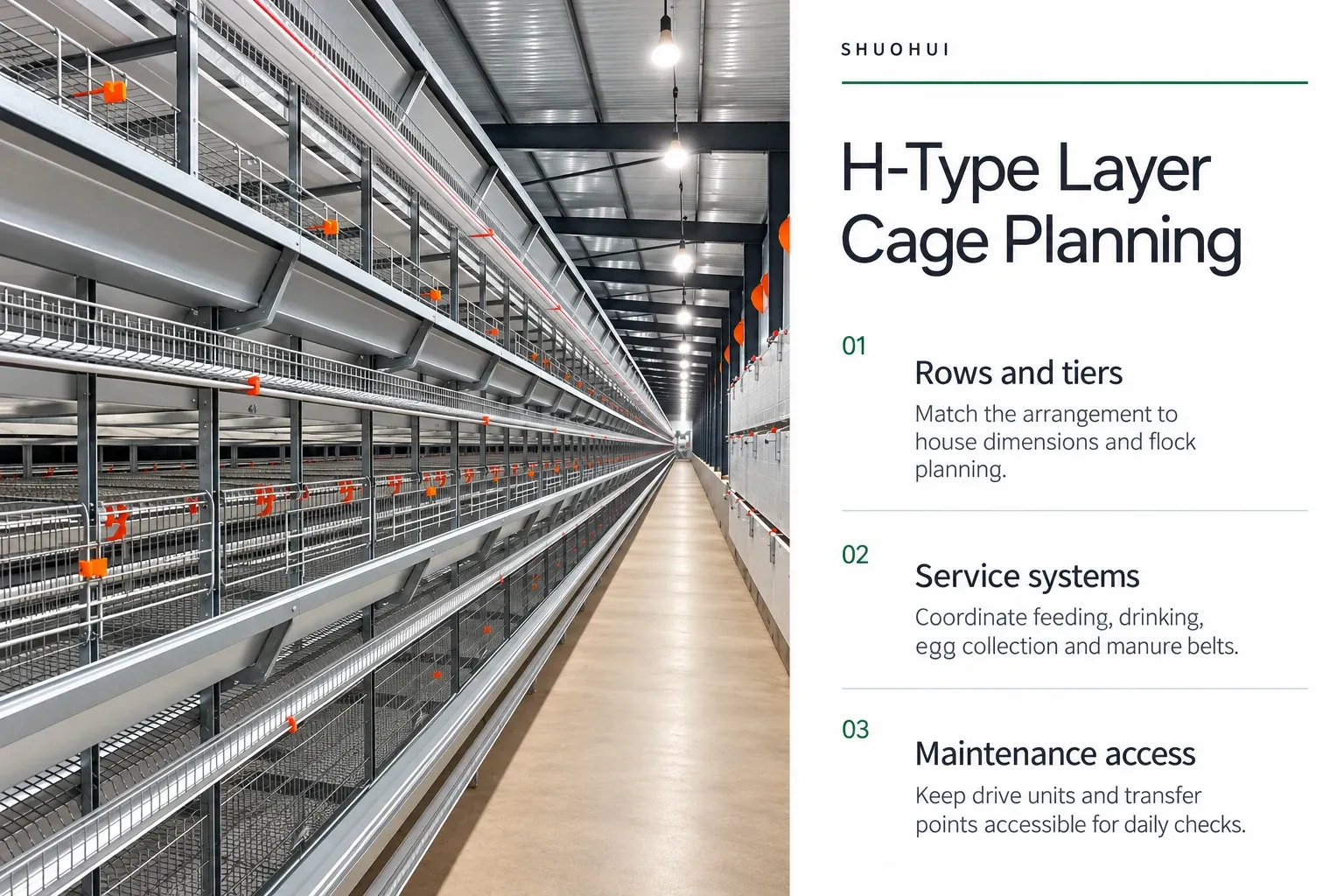
Read the selection checklist
Tier counts: choosing between 3 and 8 high
More tiers means more birds per square metre of floor, but it also raises the demands on ventilation, lighting uniformity and structural steel. A practical rule: 3 to 4 tiers suit farms with lower ceilings or manual labour on the top row; 5 to 6 tiers are the commercial sweet spot for automated houses; 8 tiers make sense only with full automation, strong tunnel ventilation and LED strips positioned to hit every level evenly. Ask the supplier how they guarantee light and airflow reach the bottom tier — that is where production quietly drops on a badly sized house.
The automation stack that comes bolted on
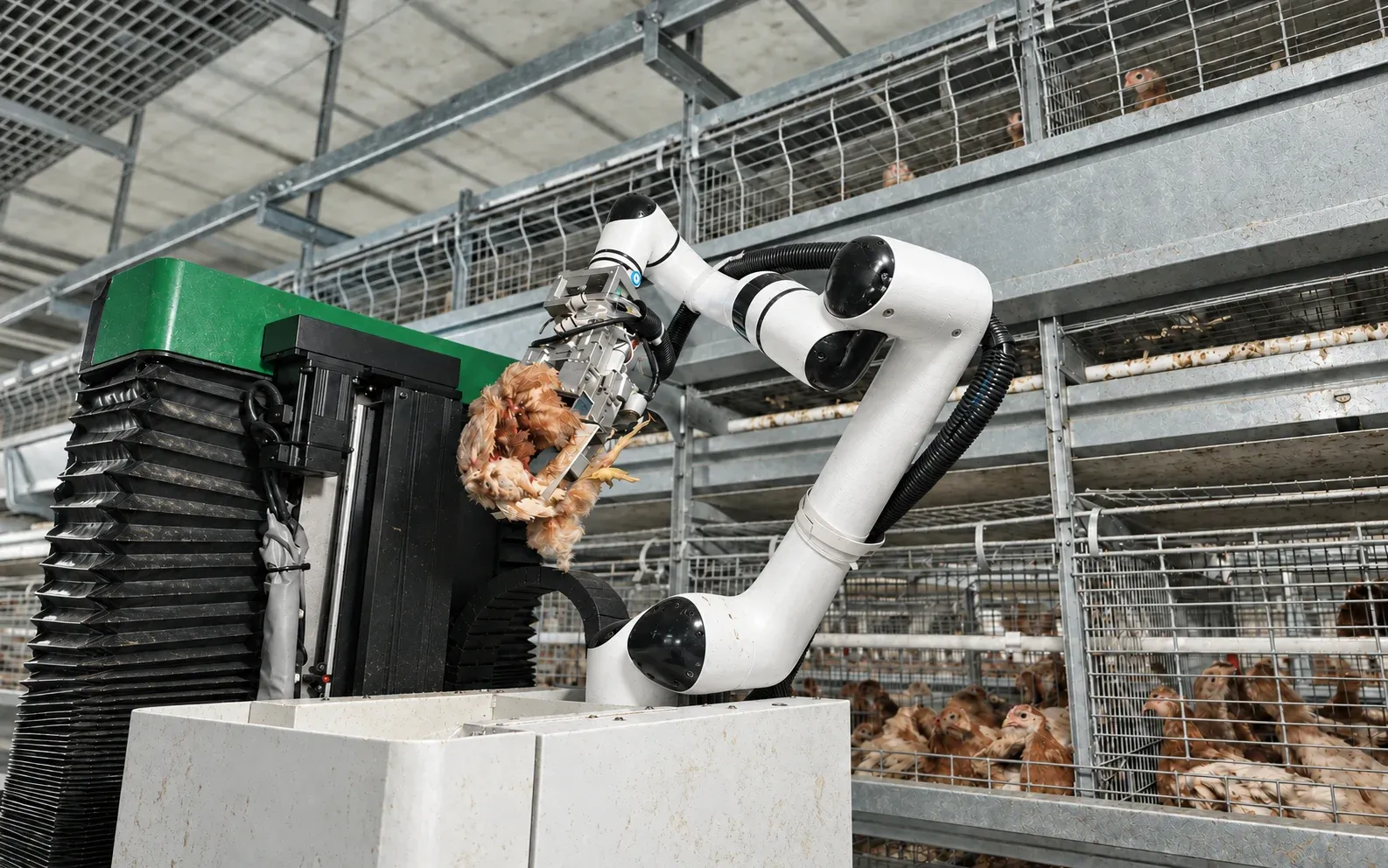
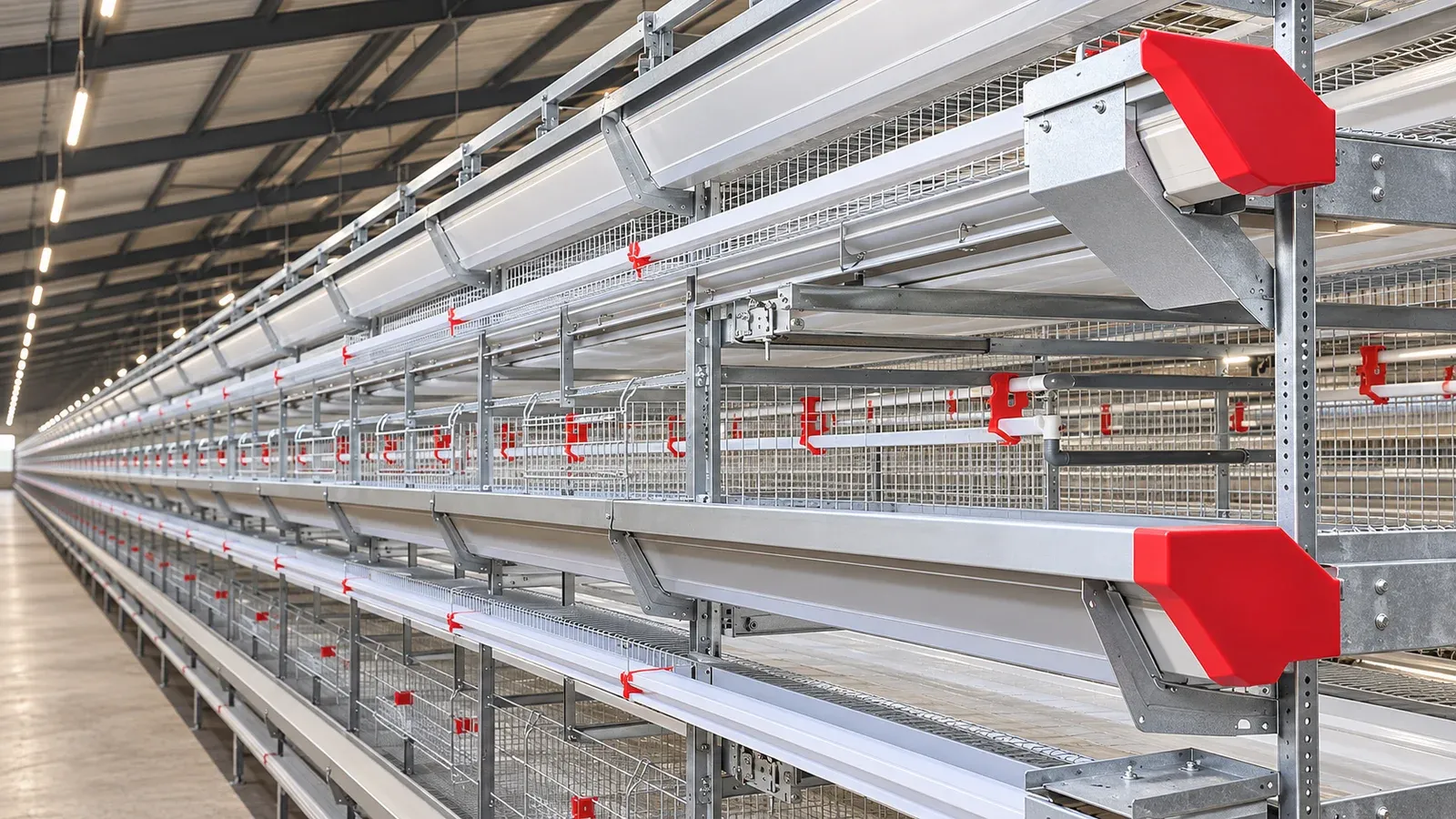
An H-type system is sold as an integrated line, not a bare cage. Standard equipment includes a travelling hopper feeder (over 95% feed distribution evenness, cutting feed waste 15 to 20% versus manual), a cone-valve nipple drinking line on 3 mm square pipe held at 0.18 to 0.22 MPa with 9 to 12 birds per nipple, per-tier manure belts, and a central egg-collection belt that pulls breakage down to 0.2 to 1% against 3 to 8% for hand gathering. One operator can run a house of around 40,000 birds once these are all in place.
H-type vs A-type: when the extra cost pays back
H-type costs meaningfully more per bird than A-type — the manure belts, taller steel and full automation roughly double the equipment spend per hen. It pays back when land is expensive or limited, when labour is costly or scarce, and when flock size is large enough that automation replaces several workers. If you are building for 20,000 birds or more on a constrained footprint, H-type usually wins. Below that, or where cheap labour and cheap land are available, A-type may be the more rational choice.
Sizing an H-type house to your bird count
Work backwards from birds, not cages. At 400 to 450 cm² of floor per hen and a 45 x 40 cm cell, count cells per group, groups per row, rows per house, then set tier count to hit your target while keeping the top tier reachable for the ventilation and light you can actually deliver. Leave aisle width for the feed hopper and a service passage, and confirm the slab and eave height before the steel is cut.
Reading the spec sheet before you buy
Four numbers separate a 20-year cage from a 5-year one: wire is hot-dip galvanized 1.56 mm (not electro-galvanized, which rusts in an ammonia house); frame steel is Q235 and hot-dipped after welding; the drinking line is food-grade with a real pressure regulator; and the manure belt is genuine PP, not recycled film that stretches. Certifications to hold the supplier to are ISO 9001, SONCAP and PVOC for African and Middle-East ports.
Send us your target bird count, house length and clear internal height, and we will return a tiered H-type layout with feeder, drinker, manure-belt and egg-collection sizing matched to your building.
Equipment views & details
ORDER & DELIVERY
Shipping process
- 01
Requirements
Share your bird type, planned capacity, destination and project needs.
- 02
Configuration and order
Confirm the equipment list, drawings, quotation and agreed order terms.
- 03
Production and inspection
Prepare and inspect the equipment against the confirmed configuration.
- 04
Packing and loading
Check the packing list and coordinate protective packing and loading arrangements.
- 05
Transport and dispatch
Arrange shipment and the required documents according to the agreed delivery terms.
- 06
Arrival and handover
Check the delivered packages and equipment, and coordinate the next installation steps.