At a glance. Inspect belt operation, egg transfers, collection-room layout and cleaning access when planning or reviewing an automatic egg collection system.
Every cracked egg is a finished product thrown away at the last moment, after the hen, the feed, and the housing have already done their work. That is what makes egg handling one of the highest-leverage places to automate on a layer farm. Manual collection is slow, it is hard on the back, and it breaks eggs: hand-gathered flocks typically lose 3-8% of their eggs to cracks and breakage. A well-designed automatic collection system pulls that loss down to 0.3-1%, with the best installations holding cracked-egg rates at 0.2% or below. At the same time it removes roughly 70-80% of the labour that hand collection demands. This guide explains how these systems work and what makes the difference between gentle and destructive handling.
The Real Cost of Cracked Eggs
A crack turns a saleable egg into a loss, so the breakage rate is one of the most direct profit levers on the farm. The gap between manual and automatic collection is large enough to change the economics of a whole house. Going from a 3-8% manual breakage rate to 0.3-1% on an automatic system means a large share of eggs that used to be downgraded or discarded now reach the packer intact.
- Manual collection: 3-8% cracked — handling, carrying, and repeated contact all take a toll.
- Automatic collection: 0.3-1% cracked — gentle, continuous movement replaces hands and trays.
- Best-in-class: 0.2% or below — careful transfers and speed control push losses to the floor.
How an In-House Collection System Is Built
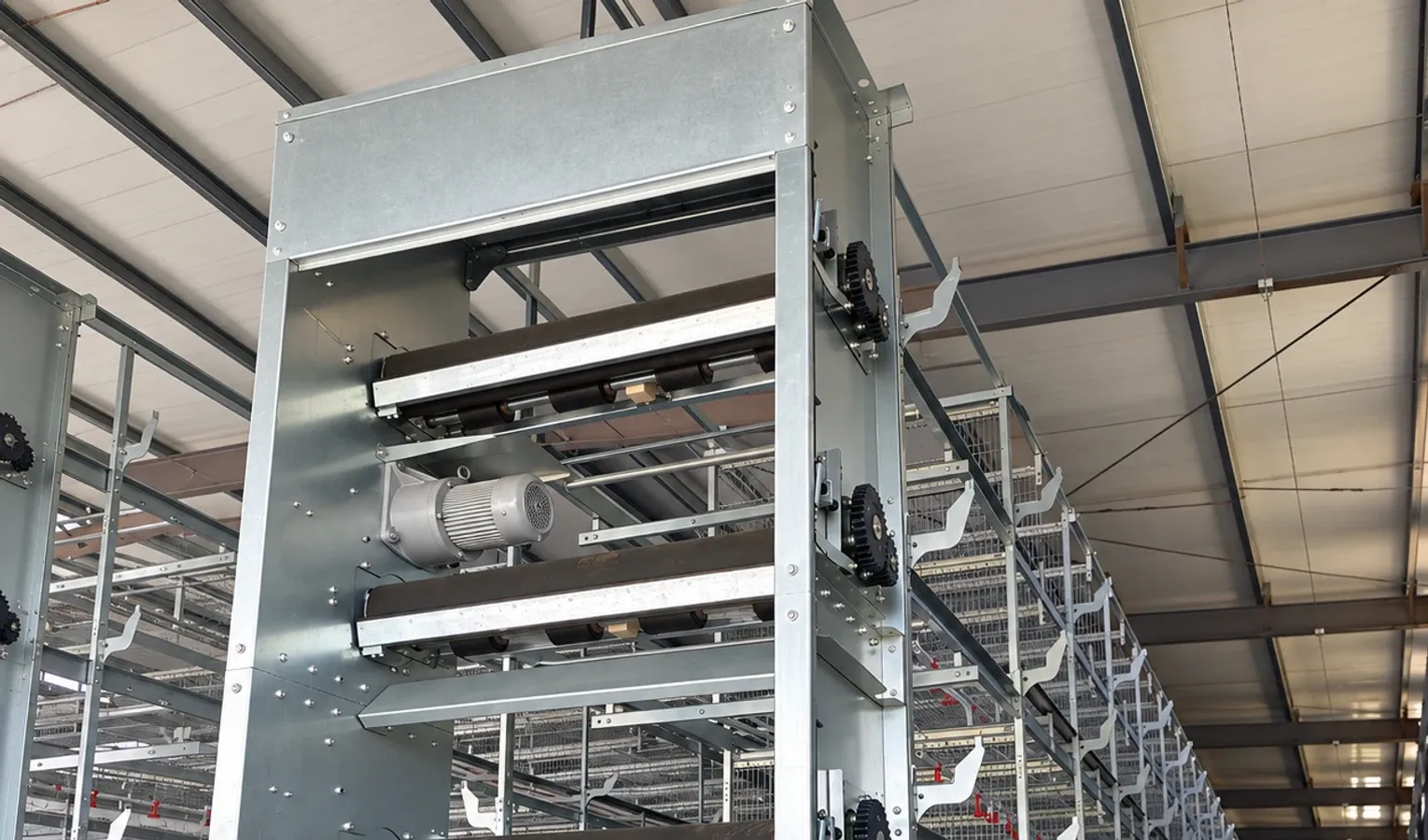
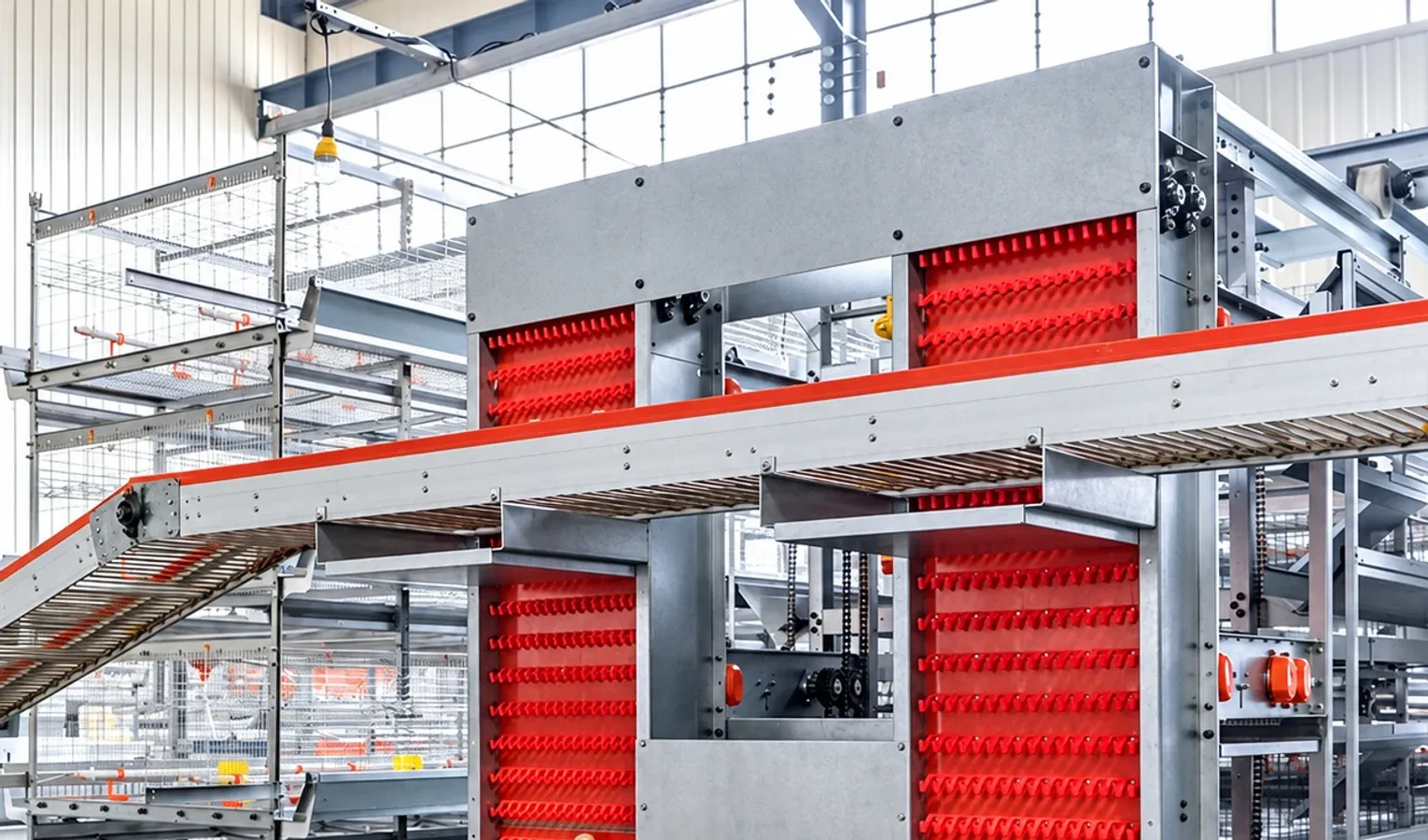
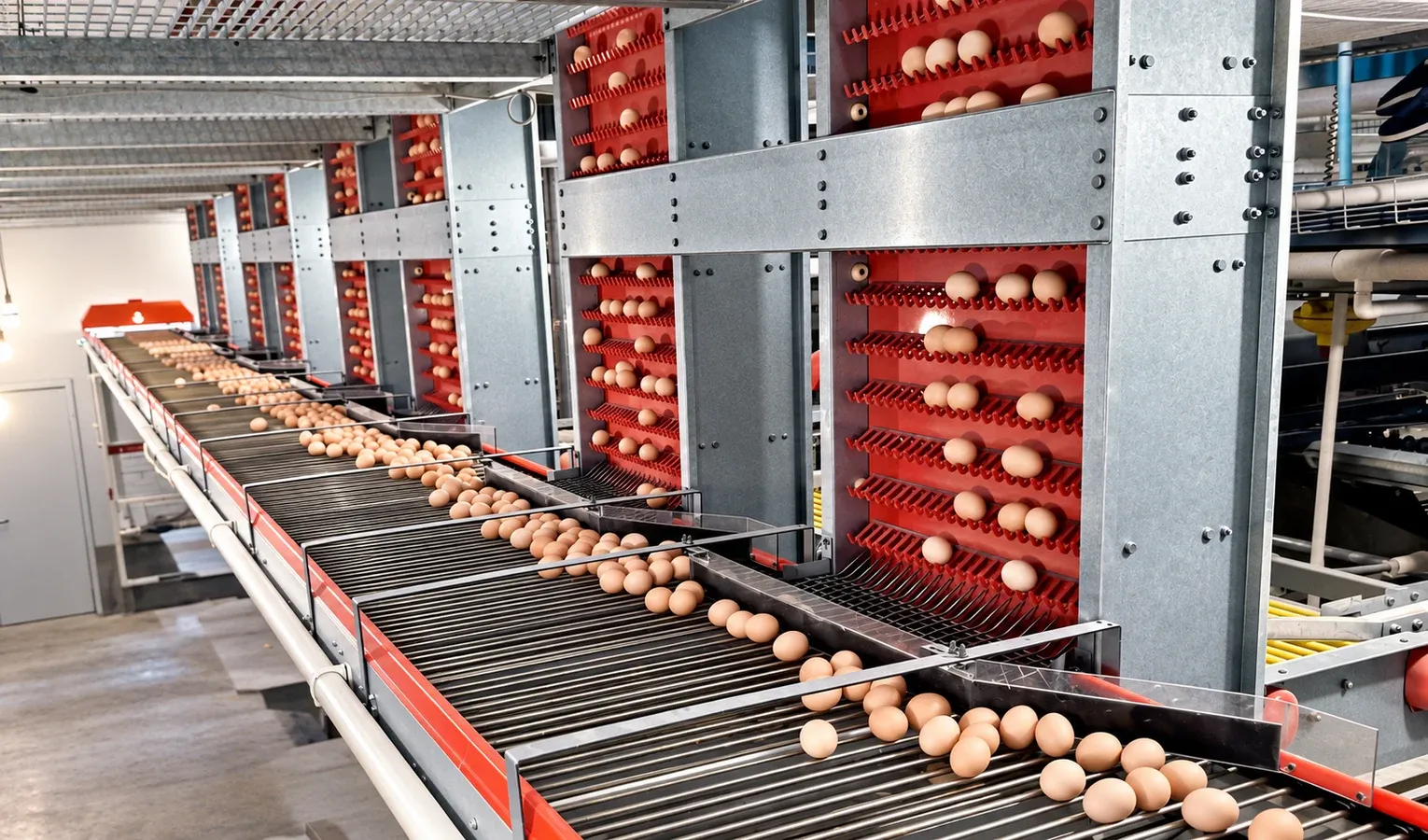
The path an egg travels is a chain of gentle handoffs, and understanding that chain explains where cracks come from and how good systems avoid them. Under each cage tier a longitudinal egg belt carries eggs to the end of the row. There they pass onto a transverse, or cross, conveyor that gathers eggs from every tier. From the cross conveyor a central elevator lifts or lowers the flow to a single level, which then runs through to the egg room or packing station.
- Longitudinal egg belt — runs under each tier and carries eggs to the row end.
- Transverse cross conveyor — collects the output of every tier into one stream.
- Central elevator — brings all tiers to a common height for packing.
- Egg room delivery — a single, tidy flow arrives ready to grade and pack.
Speed Is the Enemy of Whole Eggs
Eggs crack when they are hurried, so gentle systems run deliberately slow. In-house collection belts commonly move at around 4 to 4.5 metres per minute, a pace chosen specifically to keep impacts soft as eggs meet each other and each transfer point. It is tempting to run faster to clear a house quickly, but every extra bit of speed adds force at every handoff, and that force is exactly what turns whole eggs into cracked ones.
Throughput You Can Expect
Slow belts do not mean slow houses, because many eggs move at once across many rows. Common in-house collection belts handle roughly 15,000-17,000 eggs per hour, which is more than enough to clear a large layer house within a normal collection window. At the top end, high-speed graders and collectors can process up to about 65,000 eggs per hour, the kind of capacity used where multiple houses feed a central packing line.
- 15,000-17,000 eggs/hour — typical for in-house collection belts.
- Up to ~65,000 eggs/hour — high-speed graders and central collection lines.
Where the Labour Savings Come From
Hand collection is one of the most time-consuming daily jobs on a layer farm, and automation removes most of it. By moving eggs mechanically from cage to egg room, an automatic system cuts collection labour by roughly 70-80%. The workers who remain shift from carrying trays to overseeing the line, spotting problems, and handling the eggs only at the packing end where care matters most.
Gentle Transfers Make or Break the System
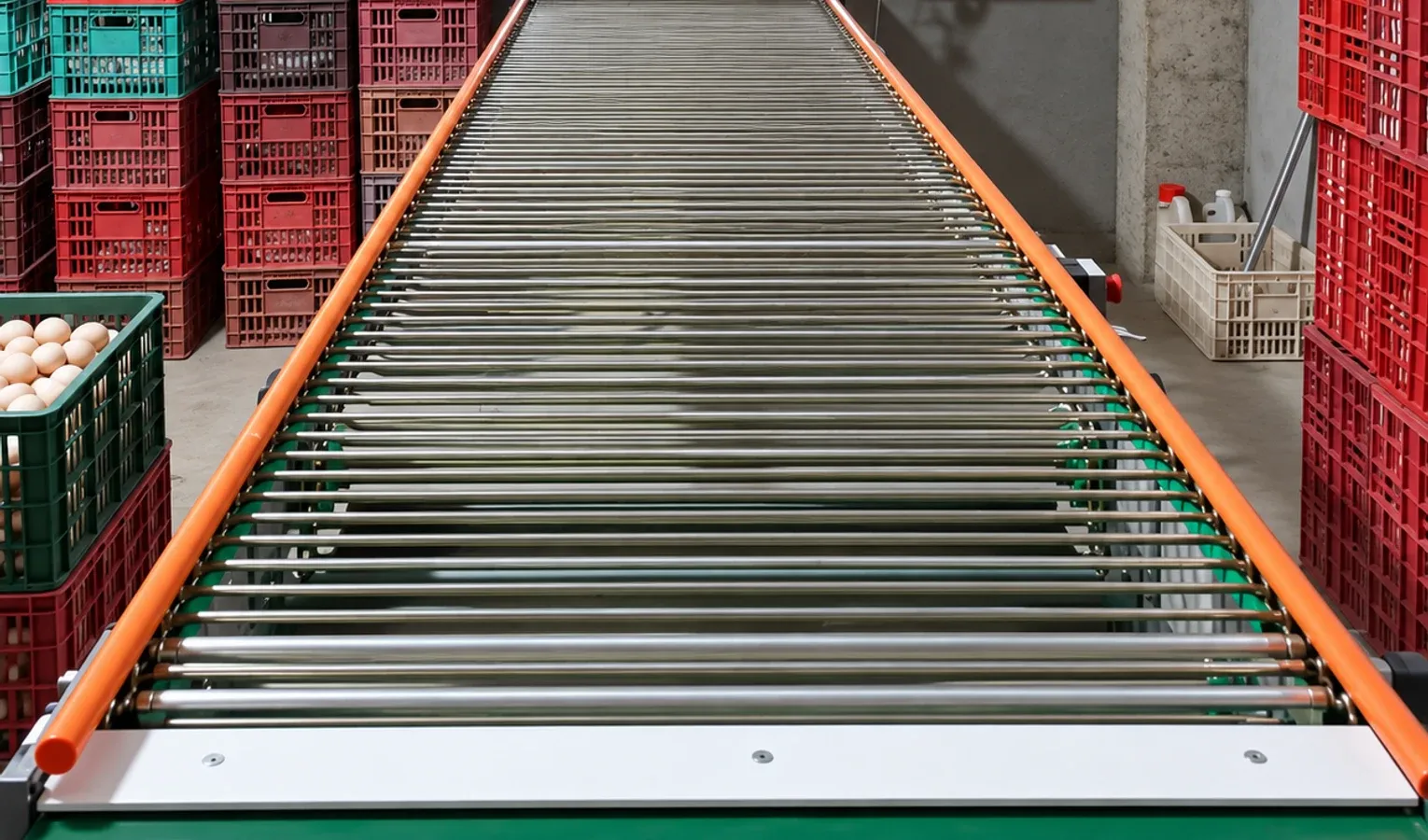
The transfer points, where an egg leaves one surface and lands on another, are where most cracks happen, so the best systems engineer these handoffs with care. Rod or roller elevators cradle eggs as they change height, egg savers cushion the moment of transfer, and curved transfers guide eggs around corners instead of letting them drop.
- Rod and roller elevators — support eggs as they rise or fall between levels.
- Egg savers — cushion the instant of transfer where impact is highest.
- Curved transfers — steer eggs smoothly around direction changes rather than dropping them.
Together these details are the difference between a system that hits 0.2% breakage and one that quietly cracks far more than it should.
Cleaner Eggs, Less Contamination
Automation does more than protect the shell; it protects hygiene too. Because eggs roll onto a belt and travel to the egg room without touching the floor or being handled repeatedly, they pick up far less dirt and bacteria along the way. Fewer points of contact mean cleaner shells arriving at packing, which supports both food safety and shelf appeal.
- Less floor and hand contact — eggs move on clean belts, not through many pairs of hands.
- Cleaner shells at packing — reduced contamination means less washing and downgrading.
Better Traceability and Throughput
A continuous mechanical flow is also a measurable one. Because eggs move through a defined path at a known rate, an automatic system makes it far easier to track output by house and by day, spot a drop in production quickly, and keep throughput high and steady. That data-friendly quality turns egg collection from a blind daily chore into a source of production insight.
- Traceability — output is tied to a house and a time, not a memory.
- Higher, steadier throughput — a machine collects at the same rate every day.
Belt Tension and Speed Matching
A collection system is only as gentle as its worst-adjusted belt. Belt tension has to be right: too loose and eggs jostle, too tight and the belt strains and eggs bounce. Just as important, the speeds of the longitudinal belt, the cross conveyor, and the elevator must be matched so that eggs flow smoothly from one to the next instead of piling up or gapping at each junction.
- Correct belt tension — keeps eggs steady and the belt tracking true.
- Speed matching across stages — prevents pile-ups and hard contact at transfers.
Synchronising With Tier Count
The system has to fit the house it serves, which starts with the number of cage tiers. The collection layout, the elevator, and the cross conveyor must all be specified to match the tier count so that every level is served evenly and no tier is left with eggs backing up. A mismatch here creates bottlenecks that no amount of gentle handling can fix.
Daily Cleaning and Maintenance
Because eggs are a food product, the belts and transfers that carry them need a daily cleaning routine to stay hygienic. Regular cleaning keeps shells clean and prevents build-up that can jam transfers or damage eggs. Alongside cleaning, a simple maintenance check on tension, tracking, and transfer points keeps the whole line running at its low breakage rate rather than drifting upward over time.
- Daily cleaning — protects hygiene and keeps transfers running smoothly.
- Routine checks — tension, tracking, and transfers inspected before problems grow.
Getting the Most From Automation
An automatic egg collection system pays back through many small gains at once: fewer cracks, far less labour, cleaner and more traceable eggs, and throughput that scales with the operation. The systems that deliver 0.2-1% breakage are the ones set up with care, run at gentle speeds, and maintained daily. If you are weighing up a collection layout for your cage rows, explore our egg collection equipment, talk with our team about matching a system to your tier count and house size, or read our related guides on layer housing and egg-room handling.
Visual checklist
Related reading
Egg Collection Layout: Transfers and Grading Access
Egg Weight Management: Nutrition and Flock Records
Further reading
Use the management guide for the actual breed, age and housing system when selecting flock targets. Review changes with the farm team and the relevant nutrition, health or equipment specialist.