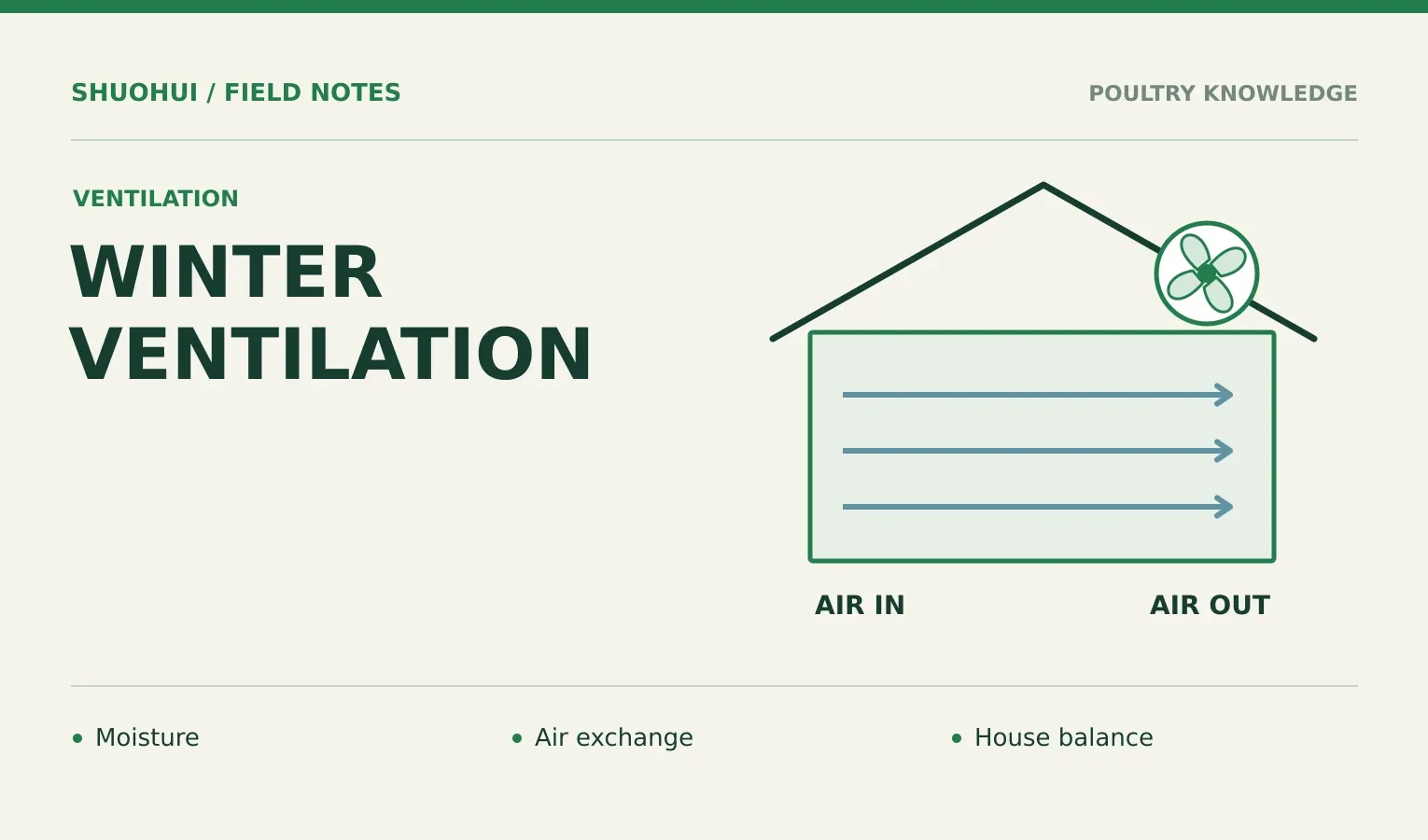
At a glance. Understand minimum ventilation, moisture removal, house tightness and inlet operation when planning winter environmental control for poultry houses.
The single most expensive mistake in cold-weather poultry management is turning the fans down too far. It feels logical: it is cold outside, the birds are producing heat, so why throw that heat away? But the number that actually drives winter ventilation is not temperature and not oxygen — it is water. A house full of birds is a house full of moisture, and if you do not exhaust that moisture you get wet litter, ammonia, respiratory disease, and a fuel bill that climbs anyway. Winter minimum ventilation is the art of exchanging the smallest possible volume of air that still keeps the house dry.
Why Moisture, Not Oxygen, Sets the Minimum
Birds consume oxygen, but the amount of fresh air needed to keep oxygen adequate is tiny compared with the amount needed to carry away water vapour. A flock breathes out moisture, the drinkers add more, and the droppings add the most of all. All of that water has to leave the building as vapour on exhausted air, or it condenses on cold surfaces and soaks into the litter.
- Oxygen demand is easily met even at very low air-exchange rates.
- Moisture load is enormous and continuous, and it is what forces you to keep the fans running.
Set your minimum ventilation to keep the house dry and the oxygen takes care of itself automatically.
The Two Sizing Rules of Thumb
There are two field formulas for a starting minimum-ventilation rate, and they agree closely:
- Roughly 75 CFM per 1,000 chicks as a baseline exhaust rate for young birds.
- Roughly 1.0 m³/h per kilogram of live body weight in the house.
Both scale with the animals in the building — more birds or heavier birds means more moisture and more required airflow. Start from one of these numbers, then adjust upward if litter is damp or humidity is high, and downward only if the house is drying out and getting cold.
Account for Unvented Heaters
If you heat with direct combustion heaters that vent their exhaust into the house (rather than out a flue), those heaters add both moisture and combustion gases to the air the birds breathe. You must add ventilation to remove them:
- Add about 2.5 CFM for every 1,000 BTU/h of unvented heater output.
- This extra airflow removes the water vapour and carbon dioxide produced by burning fuel.
Every litre of propane or gas burned produces roughly its own volume in water, so an unvented heating system quietly doubles part of your moisture problem. Vented heaters avoid this, which is one reason they are worth the extra cost in cold climates.
Run Minimum Ventilation on a Timer
At winter minimum rates, you cannot control fans on temperature alone — the house rarely gets warm enough to trigger a thermostat, so the fans would never run and moisture would build. Instead, run them on a timer cycle.
- A typical cycle runs a fan for a short on-time (for example, 1–2 minutes) within a fixed period (for example, every 5 minutes).
- The timer guarantees a baseline of fresh, dry air regardless of temperature.
- As birds grow and moisture load rises, you lengthen the on-time or add fans.
The timer becomes your moisture-control dial: more on-time when litter is wet, less when the house is drying out too fast.
Static Pressure Is the Whole Game
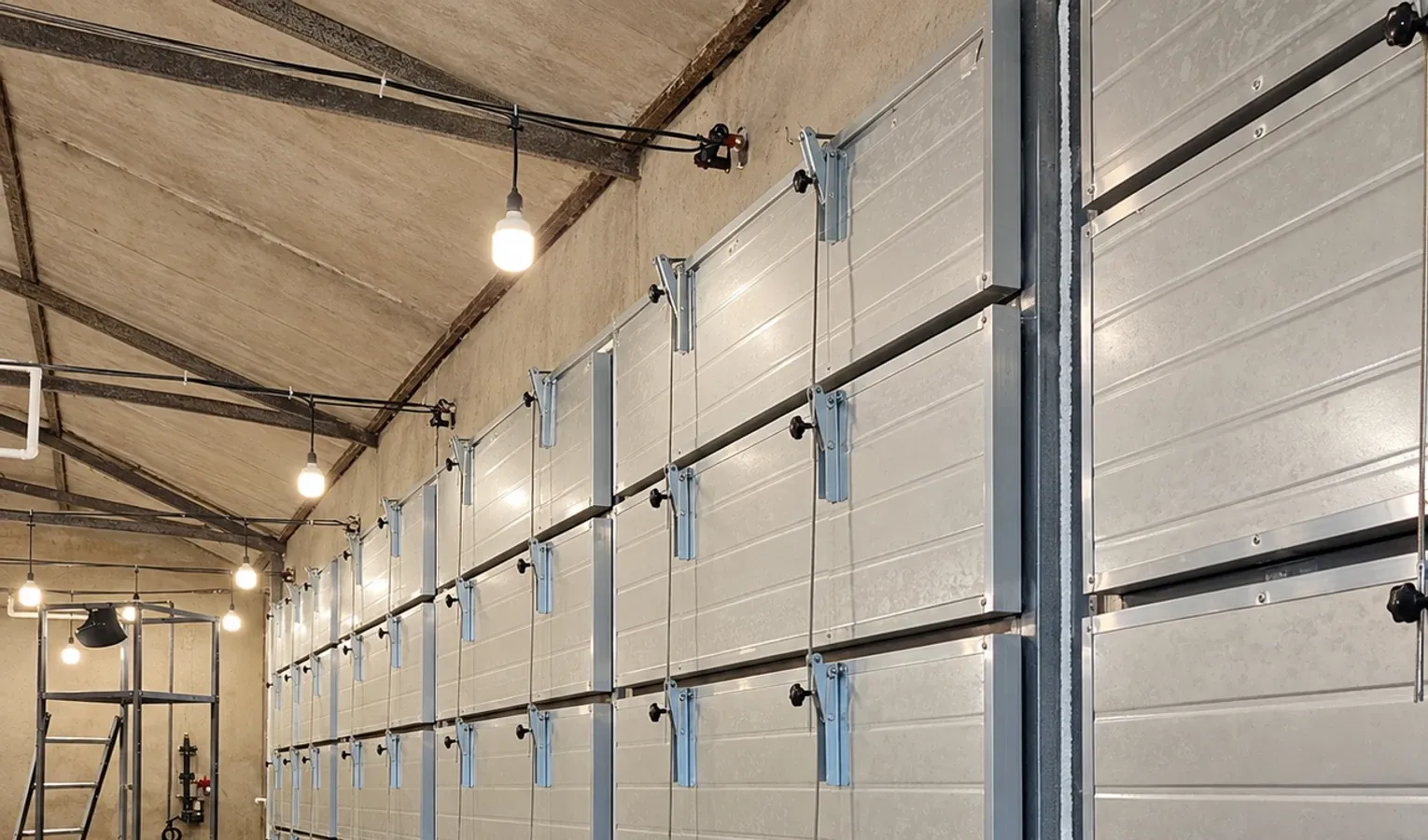
In winter, incoming cold air is heavy and wants to drop straight to the floor. If it lands on the birds, you get chilling, wet litter directly under the inlet, and huddling. The fix is static pressure — the small vacuum your fans create — which forces incoming air to jet in fast and shoot up along the ceiling, where it warms and mixes before it ever reaches the flock.
- Target a winter static pressure of about 0.10–0.15 inches of water column.
- That pressure throws the incoming jet far enough to hug the ceiling and mix with warm house air.
- Too little pressure and the cold air dumps on the birds; too much and the fans work against themselves.
Getting static pressure right is what lets you bring in freezing air without ever chilling a bird.
House Tightness Comes First
Static pressure is impossible to achieve in a leaky house. Every crack around doors, curtains, and fan shutters is an uncontrolled inlet that bleeds off pressure and lets cold air fall where you do not want it.
- Seal cracks, gaps, and worn curtains before winter.
- A tight house lets a small fan build the pressure needed to control inlet air.
- A common test is to close the house, run one fan, and confirm the pressure it produces against a target.
You cannot manage minimum ventilation you cannot measure, and you cannot measure pressure you cannot hold. Tightness is the prerequisite.
Read the Litter and the Birds
The house tells you whether your minimum ventilation is right, if you know what to read:
- Damp, capping litter or condensation on walls and ceiling means not enough air — increase timer on-time.
- Ammonia smell at bird height means moisture and litter are out of balance — ventilate more and check litter.
- Cold, huddling birds with dry litter can mean too much cold air or poor inlet mixing — check static pressure, not just fan run-time.
- Frost around inlets signals that the incoming jet is too slow and cold air is stalling.
The goal is dry litter, no ammonia sting, and birds spread evenly across the floor.
Keep Relative Humidity in a Workable Band
A practical target for house relative humidity in cold weather is roughly 50 to 60 percent. Below that, the air is dry and dusty; well above it, litter stays wet and ammonia climbs.
- If humidity climbs above the band, add ventilation even though it feels wasteful.
- If humidity falls too low, you may be over-ventilating and losing heat unnecessarily.
Relative humidity is the single best gauge of whether your moisture-removal strategy is working.
The Fuel-Cost Balancing Act
The tension in winter is real: every cubic metre of cold air you exhaust is a cubic metre you paid to heat. But under-ventilating does not save money.
- Wet litter releases ammonia, which damages the respiratory tract and opens the door to disease.
- Damp air holds and moves heat poorly, so birds actually feel colder in a humid house.
- Wet litter and sick birds cost far more than the fuel to keep the house dry.
The right minimum ventilation rate is the lowest that keeps litter dry — not the lowest you can get away with for a day.
A Winter Start-Up Checklist
Before the cold season, walk the house with this list:
- Seal every leak and confirm the house can hold 0.10–0.15 inches of static pressure on one fan.
- Set inlets to open under pressure and throw air to the ceiling.
- Program fans on a timer to deliver about 75 CFM per 1,000 chicks or 1.0 m³/h per kg.
- Add 2.5 CFM per 1,000 BTU/h of any unvented heater capacity.
- Hang a humidity gauge and target 50–60 percent.
- Check litter and bird distribution twice daily and adjust timer on-time.
Bringing It Together
Winter minimum ventilation is a moisture problem wearing a temperature costume. Size the airflow for water removal — about 75 CFM per 1,000 chicks or 1.0 m³/h per kg — add for unvented heaters, hold static pressure near 0.10–0.15 inches, and let a timer deliver a steady trickle of dry air. Do that in a tight house and you get dry litter, low ammonia, healthy respiratory tracts, and a fuel bill that is lower than the one you would face fighting wet litter all winter.
If you are specifying fans, timers, inlets, and controls to run tight minimum ventilation through a hard winter, our team can size the system to your flock and climate. Get in touch and we will help you keep the house dry without heating the whole outdoors.
Visual checklist
Related reading
Poultry House Static Pressure and Air Inlet Operation
Poultry Ventilation Modes: Cross, Transition and Tunnel
Further reading
UGA poultry ventilation resources
Check operating targets against bird age, local climate, measured house conditions and the equipment specifications. A general design example does not replace a house-specific ventilation assessment.