At a glance. Compare minimum, transitional and tunnel ventilation, including air distribution, seasonal conditions and the observations used to review operation.
Every modern poultry house runs on one climate system, but that system has to behave in three completely different ways across a single year. On a still winter night the goal is to exchange the smallest volume of air that still removes moisture. On a scorching summer afternoon the goal is to push a river of air down the house fast enough to strip heat off the birds. Between those extremes sits a wide grey zone. The professional way to manage this is not guesswork but three defined ventilation modes — cross (minimum/transitional side), transitional, and tunnel — with a simple rule for switching between them based on how many fans you are running.
The Three Modes in One Sentence
Ventilation is really a story of air speed and air volume. As outside temperature climbs, you need both to rise. The three modes describe how the house delivers that rising air:
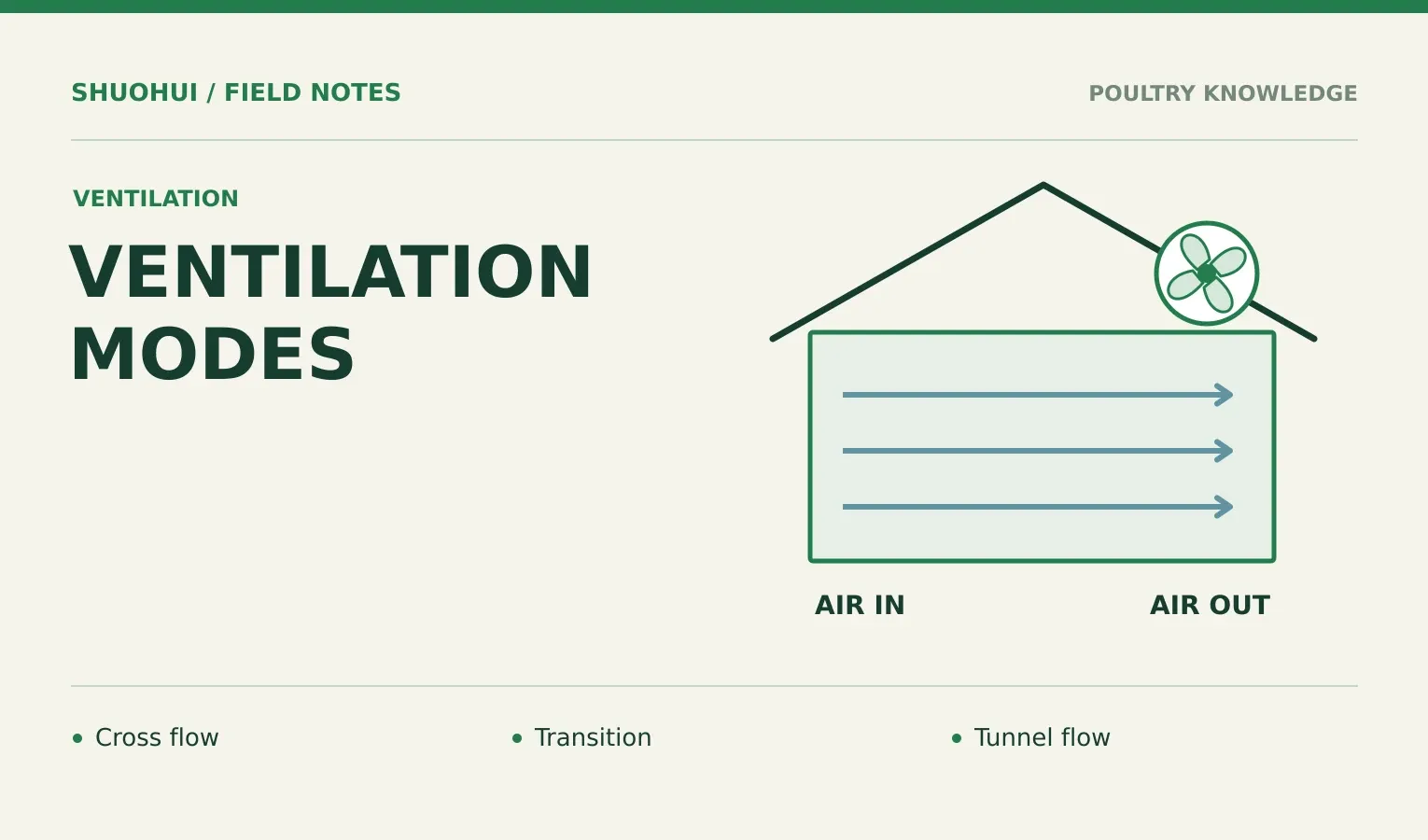
- Cross (minimum) ventilation — a few fans on one side pull air in through inlets on the opposite wall; air moves across the house at a very low speed.
- Transitional ventilation — more fans engage and sidewall inlets open wider; the house exchanges more air but still relies on mixing rather than a straight-line current.
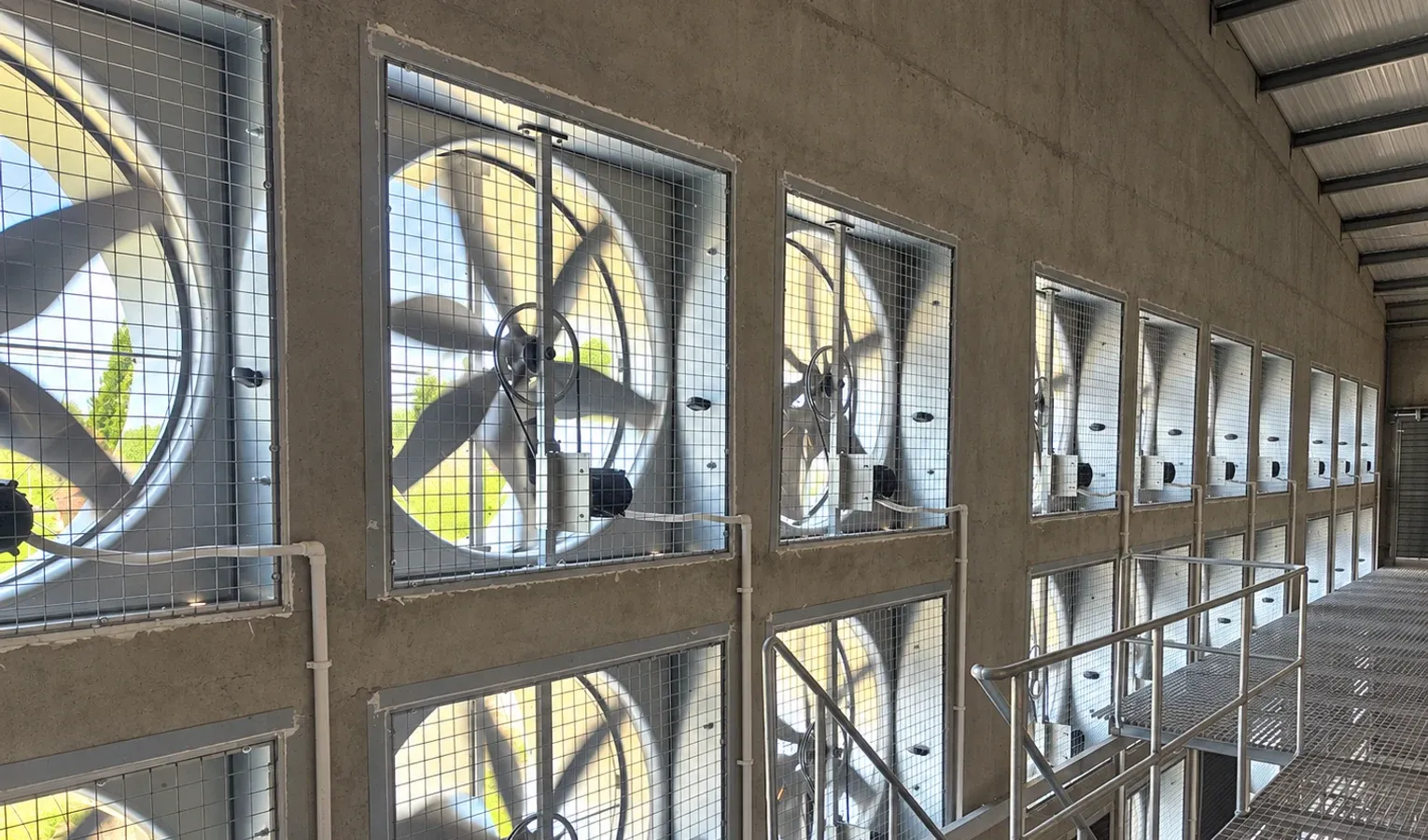
- Tunnel ventilation — a full bank of fans at one end draws air the entire length of the house past the birds, creating a fast, uniform wind.
The Fan-Count Rule for Switching Modes
The cleanest field rule ties the mode to the fraction of your total installed fans that are running:
- Fewer than half of the fans running: stay in cross/side ventilation. Air enters slowly and mixes before it reaches the birds.
- About half of the fans running: you are in the transitional zone — a blend of sidewall and tunnel behaviour.
- More than half of the fans running: commit fully to tunnel ventilation, close the sidewall inlets, and open the tunnel opening.
The reason this rule works is that trying to run tunnel airflow through small sidewall inlets, or trying to mix air gently with tunnel fans wide open, both waste energy and create cold or dead spots. Match the inlet geometry to the number of fans and the airflow pattern takes care of itself.
Target Air Speed by Season
Air speed at bird level is the number that matters most, and it changes dramatically with the season:
- Summer maximum: aim for around 3 m/s at bird height for layers and mature birds; broilers are usually run a little lower at about 2 m/s because their feathering and body mass react strongly to wind chill.
- Winter minimum: keep air movement over the birds down to 0.1–0.2 m/s, and never let it exceed 0.3 m/s. Above that, still-air winter drafts chill birds and drive up feed use.
The jump from 0.2 m/s in winter to 3 m/s in summer is roughly a fifteen-fold change in air speed, which is exactly why one fixed fan setting can never serve a house all year.
Air-Exchange Rate: The Other Half of the Story
Air speed tells you how fast air moves; air-exchange rate tells you how often the whole house volume is replaced. A useful working range is 20 to 60 air changes per hour, climbing to 60 or more in peak summer.
- In cold weather you may exchange the air only 20 times per hour or less, because the priority is holding heat while still removing moisture.
- In hot weather you push toward 60-plus exchanges per hour so that heat and humidity never accumulate.
Both numbers — air speed and exchanges per hour — should rise together as you move from cross to transitional to tunnel mode.
When to Use Cross (Minimum) Ventilation
Cross or minimum ventilation is the cold-weather and mild-weather workhorse. You run it when outside temperatures are well below the birds' comfort zone and the main job is removing water vapour and stale gases, not removing heat.
- A small number of exhaust fans run on a timer or on static-pressure control.
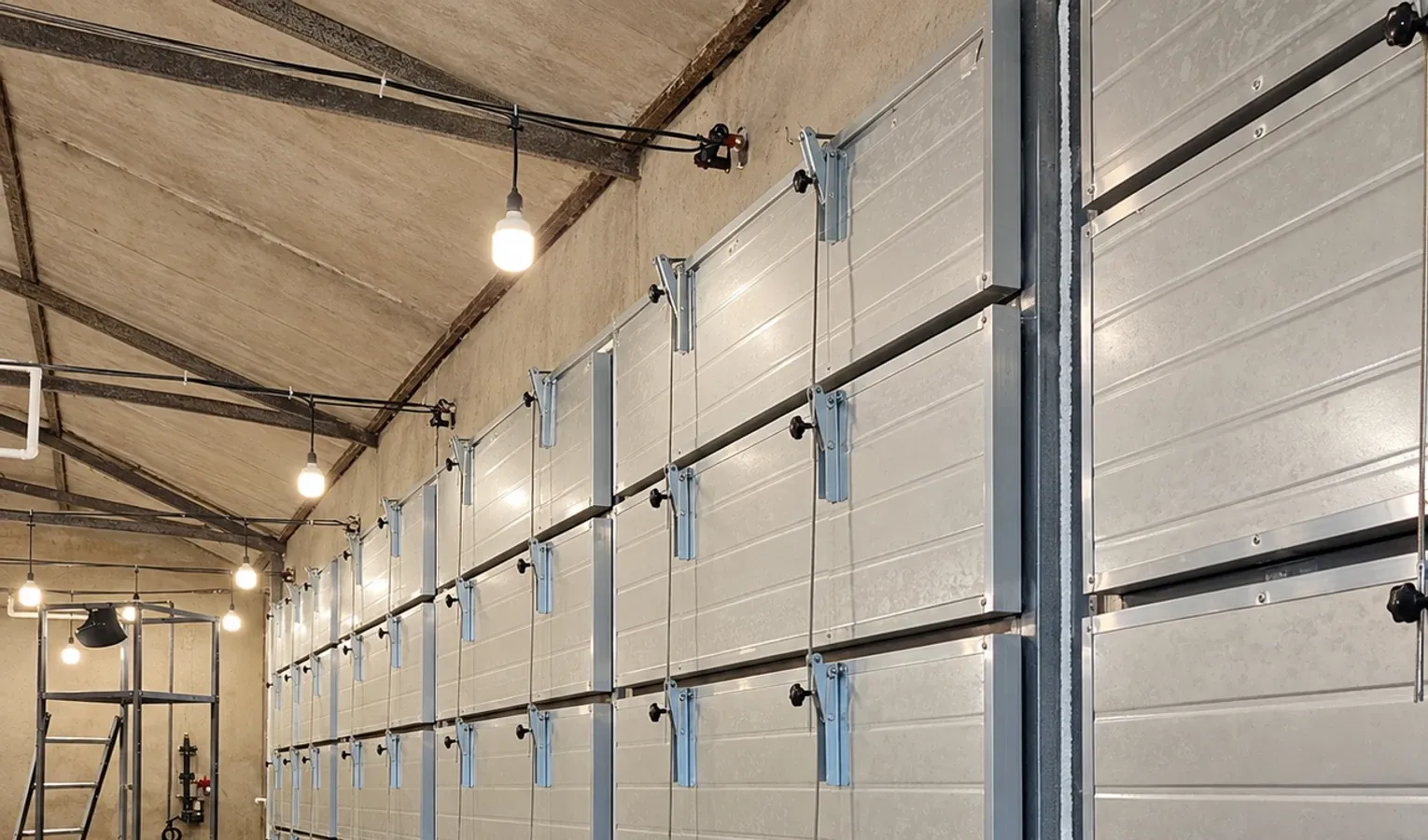
- Fresh air enters through sidewall inlets and is thrown up toward the ceiling, where it warms and mixes before dropping onto the birds.
- Air speed at the birds stays near 0.1–0.2 m/s so there is no chilling draft.
Done well, minimum ventilation keeps litter dry and ammonia low without ever making the birds feel a breeze.
When to Use Transitional Ventilation
Transitional ventilation covers the shoulder seasons and the mild part of most days. Outside temperatures are close to the birds' comfort range, so you need more air than minimum mode but not the full wind of tunnel.
- Additional fans stage on as temperature rises.
- Sidewall inlets open further to keep incoming air velocity high enough to reach the ceiling.
- The house still relies on mixing rather than a straight tunnel current, which avoids chilling younger or lighter birds.
This mode is the trickiest to tune because it sits between two very different airflow patterns; watch your static pressure and inlet opening closely.
When to Use Tunnel Ventilation
Tunnel ventilation is the hot-weather rescue system. Once more than half your fans are running and the birds still need cooling, switch to tunnel.
- A full bank of fans at one gable pulls air the length of the house.
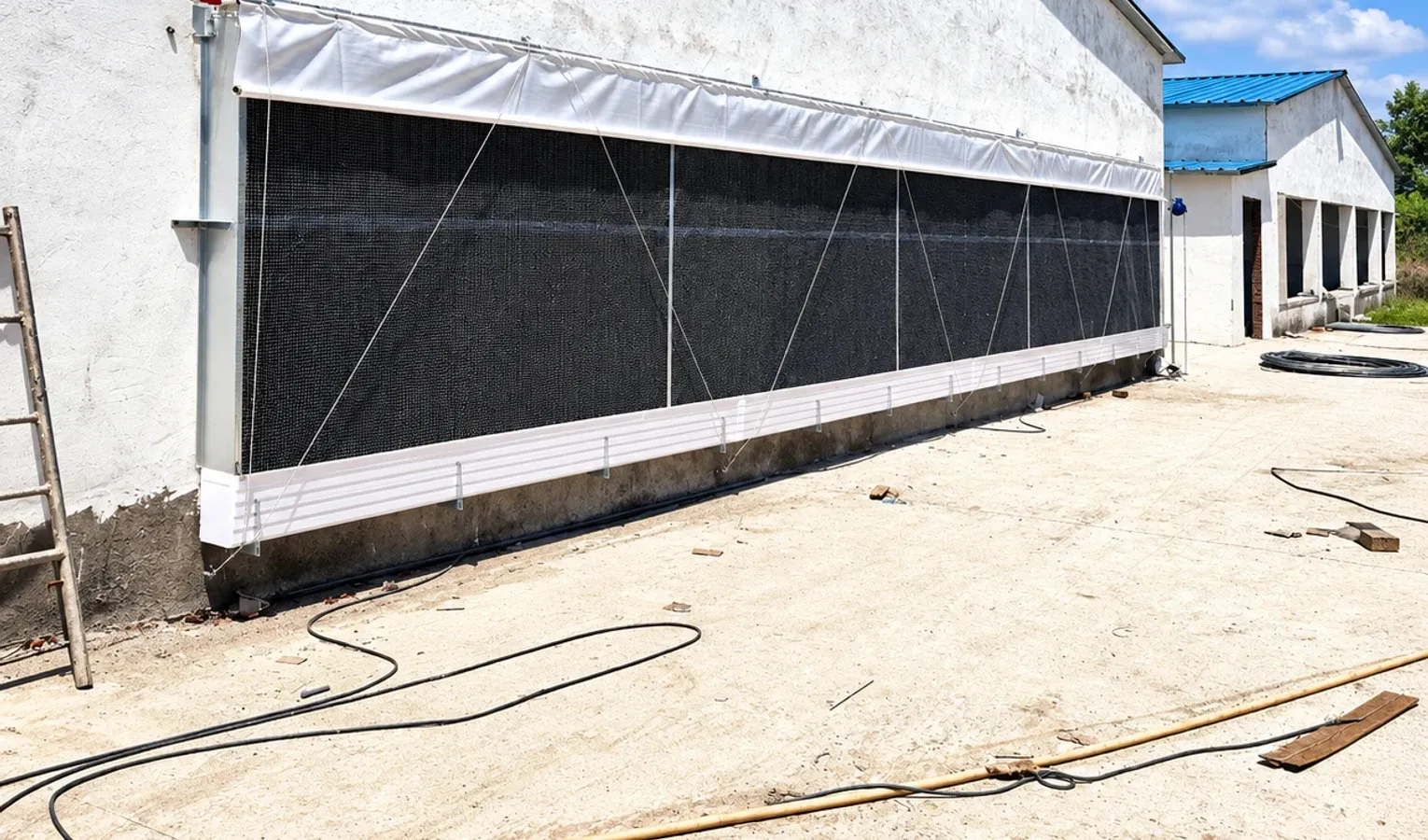
- The tunnel inlet (often paired with evaporative cooling pads) opens fully; sidewall inlets close.
- Air moves past the birds in a straight, fast current of up to 3 m/s, stripping heat away by convection and wind chill.
Tunnel airflow can make birds feel several degrees cooler than the thermometer reads, which is the whole point in summer.
How Air Speed Becomes Wind Chill
The birds do not feel the air temperature; they feel the effective temperature, which drops as air speed rises. A moving-air current of 2 to 3 m/s can make mature birds feel 5°C or more cooler than a thermometer in still air would suggest. This is why tunnel houses can keep birds productive even when outside air is warm — the wind is doing the cooling that refrigeration would otherwise have to do.
Static Pressure Ties It All Together
None of these modes work without correct static pressure, the small vacuum that a running fan creates inside a sealed house. Pressure determines how fast air jets in through the inlets.
- In minimum and transitional modes, higher static pressure throws incoming air farther across the ceiling so it mixes before falling.
- In tunnel mode, pressure drops as the large tunnel opening lowers resistance, and air simply flows through.
If the house leaks, static pressure collapses, inlet jets fall short, and cold air dumps straight onto the birds. House tightness is the foundation the three modes stand on.
A Simple Daily Decision Tree
To translate all of this into a routine an operator can run every day:
- Check bird comfort and house temperature against target.
- Note how many fans the controller is calling for.
- Fewer than half the fans: hold in cross/minimum mode, verify air speed near 0.1–0.2 m/s.
- Around half the fans: manage the transitional zone, watching inlets and static pressure.
- More than half the fans: commit to tunnel mode, close sidewall inlets, target up to 3 m/s at bird level.
Common Mistakes When Switching Modes
- Switching to tunnel too early, so young birds sit in a chilling wind they do not need.
- Staying in minimum mode too long on a warm day, letting heat and ammonia build.
- Leaking houses that never reach the static pressure the mode requires.
- Ignoring air-exchange rate, so moisture accumulates even when temperature looks fine.
Each of these traces back to treating ventilation as one fixed setting rather than three deliberate modes.
Bringing It Together
The three ventilation modes are not competing systems — they are three gears on the same machine, and the fan-count rule tells you which gear you are in. Hold air speed near 0.1–0.2 m/s in the cold, ramp through the transitional zone as the day warms, and shift to a full 3 m/s tunnel current when summer heat arrives. Match your inlets to your fans at every step and the birds stay comfortable in every season.
If you are planning a new house or upgrading fans, inlets, and controls to run all three modes cleanly, our engineering team can size the equipment to your climate, flock size, and house dimensions. Reach out and we will help you build a ventilation system that shifts gears smoothly all year.
Visual checklist
Related reading
Winter Poultry Ventilation: Moisture and Airflow
Poultry Air Speed and Effective Temperature
Further reading
UGA poultry ventilation resources
Check operating targets against bird age, local climate, measured house conditions and the equipment specifications. A general design example does not replace a house-specific ventilation assessment.