At a glance. Plan weighing, equipment access and flock observations through the rearing period, using strain-specific targets to interpret pullet development.
The laying flock you will manage for a year is largely built in the rearing house, long before the first egg. Between roughly 7 and 18 weeks, pullets develop the skeletal frame, body reserves, and flock consistency that determine how high they peak and how long they hold it. The single most powerful number in this phase is uniformity — the percentage of birds within a target band of the average weight. A flock that reaches housing with uniformity above 85% peaks higher and stays there longer than one that arrives uneven, no matter how good the layer feed is later. Uniformity is not a luxury metric — it is the clearest early signal of how the whole laying cycle will unfold, and it is one of the few things fully within the rearing manager's control. And of all the checkpoints, 16-week body weight uniformity shows the strongest correlation with peak performance. Rearing is where that uniformity is either won or lost.
Why Uniformity Beats Average Weight
A flock can hit its target average weight and still fail, because the average hides the spread. If half the birds are heavy and half are light, they mature at different times, peak at different times, and never pull together into a strong, synchronized lay.
- Uniformity measures how tightly birds cluster around the average, not just where the average sits.
- An even flock comes into lay together, producing a sharp, high peak.
- An uneven flock peaks lower and drifts, because subgroups mature weeks apart.
The 85% Target and How to Measure It
Uniformity is expressed as the percentage of birds within a set band (commonly plus or minus 10%) of the flock average weight, or equivalently through the coefficient of variation (CV). The two are mirror images of the same idea.
- Target flock uniformity above 85%, with 80% as the practical floor.
- Equivalently, keep the CV under about 8-10% on body weight.
- A CV above 12% is the trigger for corrective action — the flock is too spread out to leave alone.
Weigh Early, Weigh Often
You cannot manage what you do not measure, and uniformity is invisible without regular weighing. Sampling body weight on a schedule turns a vague impression into a number you can act on.
- Begin routine sample weighing from around week 4-7 and continue weekly.
- Weigh a representative sample — commonly 1-2% of the flock or 60-100 birds — from several points in the house.
- Weigh at the same time of day, ideally the same weekday, so trends are comparable.
Build the Frame First
The skeleton and vital organs develop early, and a pullet that misses her frame targets in the first weeks cannot fully compensate later. Early feed intake and gut development set up everything that follows.
- The first weeks build the skeleton, gut, and immune system — the platform for later reserves.
- A pullet that falls behind early tends to stay behind through the whole rear.
- Prioritize early feed access and gut health to hit the initial weight and frame targets.
Shank Length: The Skeletal Checkpoint
Body weight alone can mislead, because a fat bird and a well-framed bird can weigh the same. Shank (tibia) length is a direct read on skeletal development and is worth tracking alongside weight.
- Target a shank length of at least 50 mm by about week 4 as a frame milestone.
- Track shank uniformity too — even skeletons underpin even birds.
- A light bird with a normal shank is under-conditioned; a heavy bird with a short shank matured too fast.
Reading the Two Failure Modes
Uneven flocks fail in two characteristic ways, and they call for opposite responses. Recognizing which one you have prevents making the problem worse.
- Light body weight with normal shank: an under-fleshed bird that lays small eggs and climbs to peak slowly.
- Overweight with short shank: an early-maturing bird prone to prolapse, double-yolk eggs, and higher mortality.
- Diagnosing the pattern tells you whether to push intake or slow maturity.
Grading: The Tool for a Spread-Out Flock
When uniformity slips below target, the fix is to physically separate the flock by weight and feed each group to its needs. Grading is the most direct lever you have on uniformity.
- When CV exceeds 12%, weigh the whole flock and split into light, medium, and heavy pens.
- Feed lighter birds a richer or more accessible ration to help them catch up.
- Re-check after a few weeks and regroup as the spread tightens.
Feeder and Drinker Space Drive Evenness
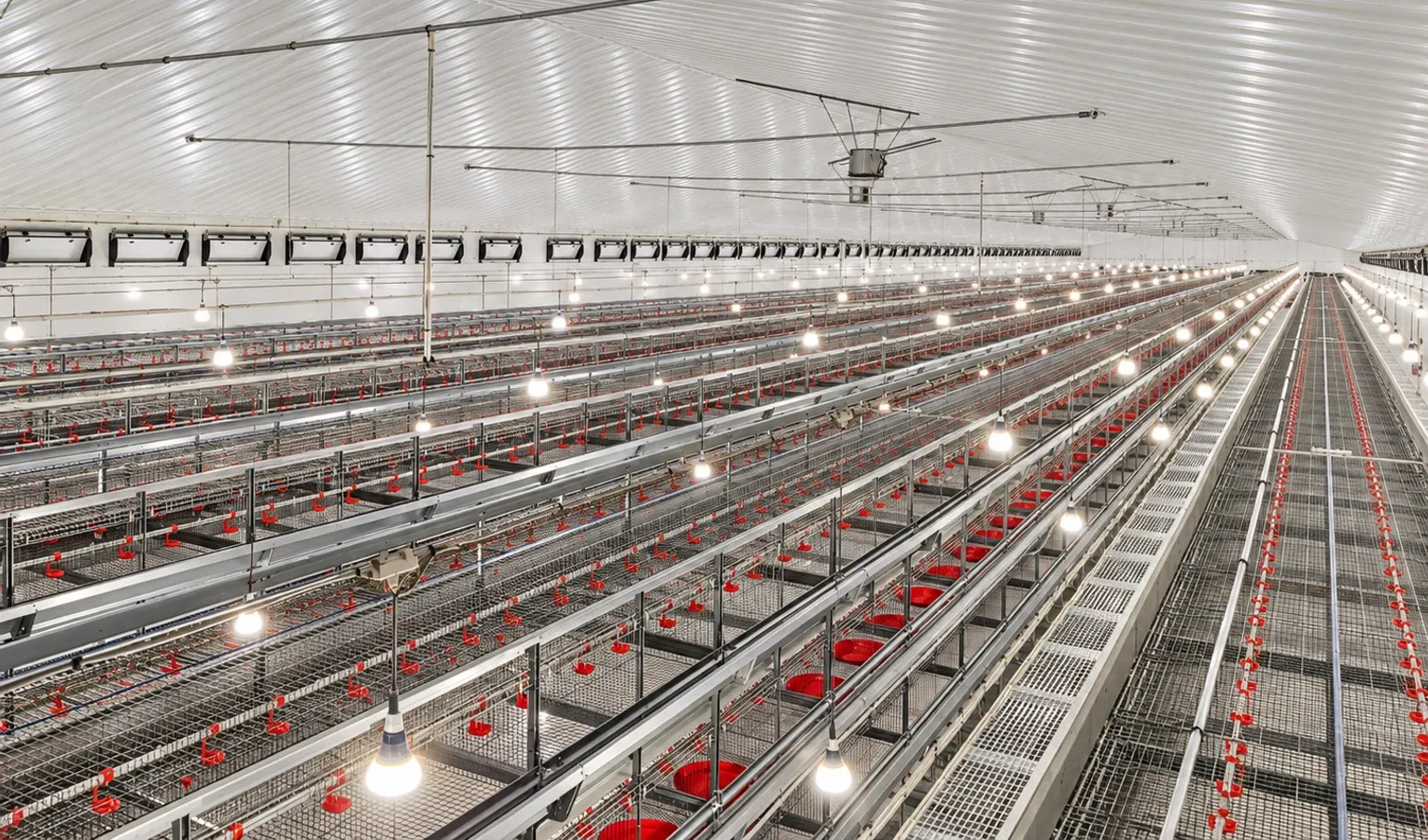
Much poor uniformity is simply competition. If timid birds cannot reach feed and water, they fall behind, and the gap widens week after week. Adequate, well-distributed equipment is a uniformity tool.
- Provide enough feeder space that all birds can eat at once during main feeding.
- Distribute drinkers so no bird has to travel far or fight for water.
- Empty feeders periodically so subordinate birds get a full share of every nutrient.
The 16-Week Checkpoint
If there is one weight to get right, it is the 16-week body weight. Its uniformity correlates most strongly with peak production and peak duration, because it reflects the reserves the bird carries into photostimulation.
- Prioritize hitting both the target average and tight uniformity at 16 weeks.
- A well-conditioned 16-week flock responds sharply to light stimulation and peaks strongly.
- Correcting problems is far harder after 16 weeks than before.

Build Pre-Lay Reserves
In the final rearing weeks, pullets should be gaining well and carrying body reserves above the maintenance line, because the onset of lay draws heavily on those reserves. Under-conditioned birds crash after peak.
- Aim for pre-lay body weight around 5-8% above the standard to build reserves.
- Steady weight gain right up to housing signals a flock ready to lay.
- Reserves laid down now buffer the huge demand of climbing to peak.
Health and Handling Events Affect Uniformity
The rearing period is also when vaccinations, and sometimes beak trimming, take place — and every stressor is a potential setback that can widen the spread if it hits birds unevenly or at the wrong time. Planning these events protects the uniformity you are working to build.
- Schedule vaccinations and any beak trimming to minimize overlap with other stressors.
- A poorly timed or uneven procedure can knock lighter birds back and widen the CV.
- Support birds through each event with easy feed and water access so recovery is even across the flock.
Timing the Onset of Lay
Uniformity and body weight, together with the light program, determine when the flock starts laying. Well-reared, uniform pullets typically come into production at 19-21 weeks, sharply and together.
- Expect onset of lay around 19-21 weeks in a well-managed, uniform flock.
- Both body weight and light readiness must align — one without the other gives a poor start.
- A synchronized onset is the payoff of a uniform rear.
Turning Uniformity Into a Routine
Uniformity is not a one-time measurement but a discipline maintained across the whole rear. The operations that consistently produce even flocks do the same simple things every week.
- Weigh a fixed sample weekly; calculate average, uniformity, and CV every time.
- Compare against the breed standard and act when uniformity drops or CV climbs above 12%.
- Track shank length, manage feeder space, and grade when needed to hold the flock together.
Uniform pullets are quiet insurance on a full year of production. The reserves and evenness you build between 7 and 18 weeks pay back as a higher, longer peak. If you are setting up or upgrading a rearing house, it is worth ensuring feeder and drinker layout, plus your weighing routine, are built to protect uniformity — because an even flock is the foundation every strong lay is built on.
Visual checklist
Related reading
Pullet Uniformity: Measuring and Managing Variation
Pullet Lighting: Rearing and Transfer Planning
Further reading
Use the management guide for the actual breed, age and housing system when selecting flock targets. Review changes with the farm team and the relevant nutrition, health or equipment specialist.