At a glance. Explore the relationship between mineral nutrition, feed intake and shell formation, and identify records to review with a layer nutritionist.
An eggshell looks simple and is anything but. Each one is roughly 95% calcium carbonate, laid down in a matter of hours, mostly overnight, while the hen is not eating. That single fact — that the busiest phase of shell formation happens when the feed trough is quiet — drives almost every practical decision about calcium and phosphorus nutrition in layers. It is why coarse limestone matters, why the calcium-to-phosphorus ratio is a lever you can pull too far, and why simply dumping more calcium into the diet often backfires. This guide unpacks the chemistry and turns it into feeding decisions.
The Shell Is Mostly Calcium Carbonate
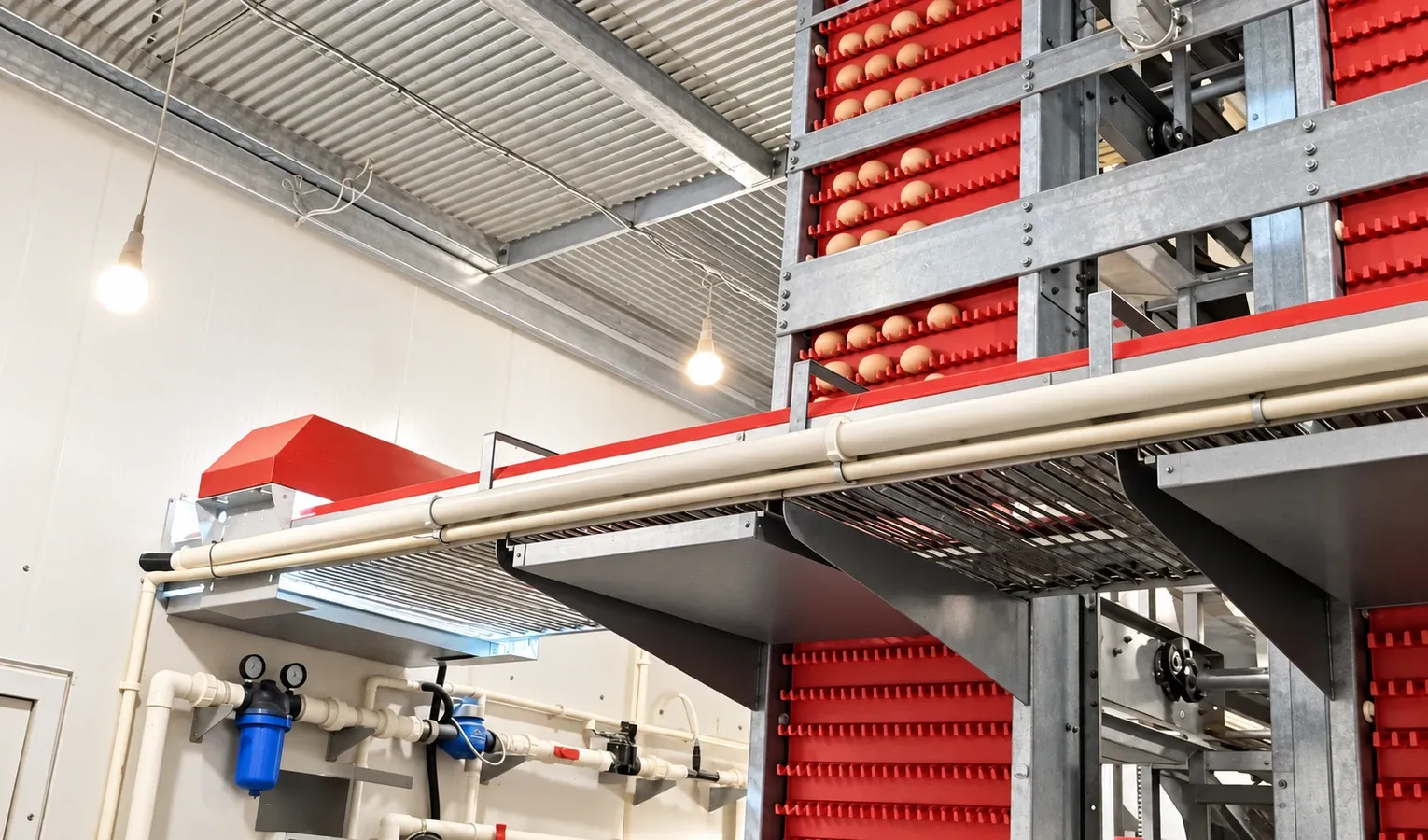
Before anything else, hold onto the core number: the shell is about 95% calcium carbonate. Each egg carries roughly 2 grams of calcium locked into that shell. Multiply that across a near-daily laying rate and you see why calcium demand dominates layer nutrition in a way it never does for broilers.
- Shell ~95% CaCO3
- ~2 g calcium per egg
- Near-daily laying makes calcium the defining nutrient of the layer diet
How Much Calcium a Hen Really Needs
A laying hen needs about 4-5 grams of calcium per day to keep making sound shells. On the diet side, that translates to a calcium level of 3.5-4.5% of the ration — dramatically higher than any growing bird requires. Miss this and shell quality is the first thing to crack, literally.
- ~4-5 g calcium/day per laying hen
- Dietary calcium 3.5-4.5%
- Far above the needs of pullets or broilers
The Overnight Shell-Forming Window
Shell calcification runs largely at night, long after the last meal. The hen must therefore either have calcium still available in her gut or pull it from her skeleton. Diet supplies roughly 60-70% of shell calcium; the remaining 30-40% is mobilized overnight from medullary bone, a specialized reserve tissue inside her bones. Managing the shell means managing both sources.
- Shell forms mostly overnight, away from feeding
- Diet supplies ~60-70% of shell calcium
- ~30-40% is mobilized from medullary bone during the night
Why Particle Size Is a Hidden Lever
Not all calcium behaves the same in the gut. Fine calcium dissolves and is absorbed quickly during the day; coarse particles sit in the gizzard and dissolve slowly, releasing calcium through the night exactly when the shell is forming. Sizing the calcium source to 0.8-2.0 mm — coarse limestone or oyster shell — gives that overnight release. Particle size, not just total calcium, often separates good shells from thin ones.
- Calcium particle size 0.8-2.0 mm for overnight release
- Coarse limestone or oyster shell dissolves slowly in the gizzard
- Fine calcium is used in the daytime; coarse is held back for night
The Fine-Plus-Coarse Strategy
The practical answer is a blend. A mix of fine and coarse calcium covers both windows: fine particles handle daytime absorption and body needs, while coarse particles are retained in the gizzard and trickle calcium out overnight during peak shell formation. This dual-supply approach is one of the most reliable shell-quality tools available.
- Blend fine + coarse calcium sources
- Fine for daytime use; coarse for overnight shell formation
- A simple, robust way to steady shell quality across the day-night cycle
Phosphorus: The Quiet Partner
Calcium gets the attention, but phosphorus is its metabolic partner in bone and shell. Layers need available phosphorus around 0.38-0.45%. Too little weakens the skeleton the hen depends on for overnight calcium mobilization; too much disturbs the mineral balance. Phosphorus has to be right for calcium to work.
- Available phosphorus 0.38-0.45%
- Supports the skeleton the hen draws on overnight
- Must be balanced against calcium, not maximized
The Calcium-to-Phosphorus Ratio
The ratio between the two minerals is a genuine tightrope. Push the calcium-to-phosphorus ratio above 10:1 and you depress feed intake — the hen simply eats less, dragging down every other nutrient. Let it fall below 8:1 and shell thickness can drop by around 12%. The window between these extremes is where good shells live.
- Ca:P above 10:1 depresses feed intake
- Ca:P below 8:1 reduces shell thickness by ~12%
- Keep the ratio in the balanced middle band
Vitamin D3 and Calcium Absorption
Minerals do not absorb themselves. Vitamin D3 is essential for the hen to take calcium up from the gut and regulate its metabolism, with supplementation around 125 µg/kg of diet supporting efficient absorption. Without adequate D3, even a calcium-rich diet underperforms because the bird cannot use what it is given.
- Vitamin D3 ~125 µg/kg aids calcium absorption
- Enables the hen to use dietary calcium, not just consume it
- A calcium-rich diet still fails without adequate D3
Manganese and Zinc for Shell Structure
Shell strength is not only about calcium quantity — it is also about architecture. Manganese and zinc support the shell membrane and the crystalline ultrastructure that gives the shell its resilience. A shell can carry enough calcium yet still be brittle if these trace minerals fall short, so they belong in any serious shell-quality program.
- Manganese and zinc support shell membrane and ultrastructure
- Contribute to shell resilience, not just thickness
- Trace-mineral shortfalls can produce brittle shells despite adequate calcium
The Aging Hen Problem
Shell quality classically declines in late lay, and the biology explains why. Older hens absorb calcium less efficiently and lay larger eggs, spreading a similar amount of shell material over more surface area. The result is thinner, weaker shells in the flock's final weeks — a well-known and frustrating pattern for producers.
- Older hens absorb calcium less efficiently
- Larger late-lay eggs spread shell over more surface area
- Together these drive late-lay shell weakening
Why "More Calcium" Is the Wrong Fix
The instinctive response to weak shells — pour in more calcium — often makes things worse. Adding blind, excess calcium does not overcome poor absorption, and it actively inhibits the uptake of zinc and manganese, the very trace minerals that support shell structure. The smarter path is particle size, D3, trace-mineral balance, and phosphorus — not brute-force calcium.
- Excess "blind" calcium does not fix late-lay shells
- High calcium inhibits zinc and manganese absorption
- Fix shells with particle size, D3, trace minerals and Ca:P balance instead
Timing the Calcium Meal
Because the shell forms overnight, when calcium is offered matters as much as how much. Many producers see better shells when the heavier, coarser calcium is available in the afternoon, so it is sitting in the gizzard as the hen enters her dark-period shell-building phase. Splitting or timing calcium delivery to load the gut before lights-out reduces how much the hen has to strip from her own bones each night, protecting both shell quality and skeletal health over a long cycle.
- Offer coarse calcium later in the day so it is present overnight
- Reduces nightly bone calcium withdrawal
- Protects both shell quality and skeletal integrity across the cycle
Reading the Warning Signs
Shell problems announce themselves before they become expensive if you know what to watch. Thin or translucent shells, rough or pimpled surfaces, and a rising rate of cracks and breakage on collection all point back toward the calcium-phosphorus system — particle size, ratio, D3, or trace minerals. Tracking downgrades and breakage over time turns shell quality from a vague worry into a measurable signal you can act on before it dents your saleable-egg percentage.
- Thin, translucent, or rough shells flag a mineral problem
- Rising cracks and breakage are an early economic warning
- Track downgrades over time to catch drift before it costs sales
Building a Shell-Quality Program
Put together, a strong shell comes from a system, not a single number: adequate total calcium, the right particle-size blend for overnight release, balanced phosphorus and a sensible Ca:P ratio, sufficient vitamin D3, and supporting manganese and zinc — adjusted as the flock ages. Every figure here is a typical range that shifts with breed, age, and climate, so consult your breed guide or a local nutritionist or vet when you fine-tune a program.
- Combine total calcium, particle size, phosphorus, D3, and trace minerals
- Adjust the program as the flock ages
- Treat all values as typical ranges and confirm with your breed guide or a nutritionist/vet
Strong shells are really a timing problem solved by chemistry — putting the right calcium in the right place so it is ready the moment the hen needs it, in the dark. If you are working to lift shell quality and want housing and feeding equipment that keep calcium sources delivered cleanly and consistently, explore our layer equipment range or talk with our team about your setup.
Visual checklist
Related reading
Layer Calcium Nutrition: Intake and Particle Size
Thin Eggshells: A Flock Troubleshooting Guide
Further reading
Use the management guide for the actual breed, age and housing system when selecting flock targets. Review changes with the farm team and the relevant nutrition, health or equipment specialist.