At a glance. Understand the purpose of broiler feeding phases and review transitions, feed form, water access and performance against strain-specific guidance.
Few things in poultry production reward precision like broiler feeding. A bird that reaches slaughter weight in six or seven weeks lives its entire life on a compressed nutritional timeline, and every phase has a job to do. The three-phase system — starter, grower, finisher — exists because the bird's needs swing sharply from a protein-hungry chick into an energy-hungry, fast-growing juvenile. Feed the phases correctly and you can push feed conversion toward the industry's best numbers, with good flocks landing an FCR of 1.6-1.85 and the sharpest operations dipping below 1.6. Here is how the phases fit together.
Why Three Phases Instead of One
A broiler's protein requirement, expressed as a percentage of the diet, is highest when it is small and falls as it grows, while its appetite for energy rises as it packs on weight. A single diet cannot track both curves. Splitting the grow-out into three windows lets you match the ration to the bird and avoid paying for protein the finishing bird no longer needs.
- Protein descends, energy ascends across the three phases
- Matches the diet to a rapidly changing growth curve
- Cuts the cost of overfeeding protein late in the cycle
The Three-Phase Timeline
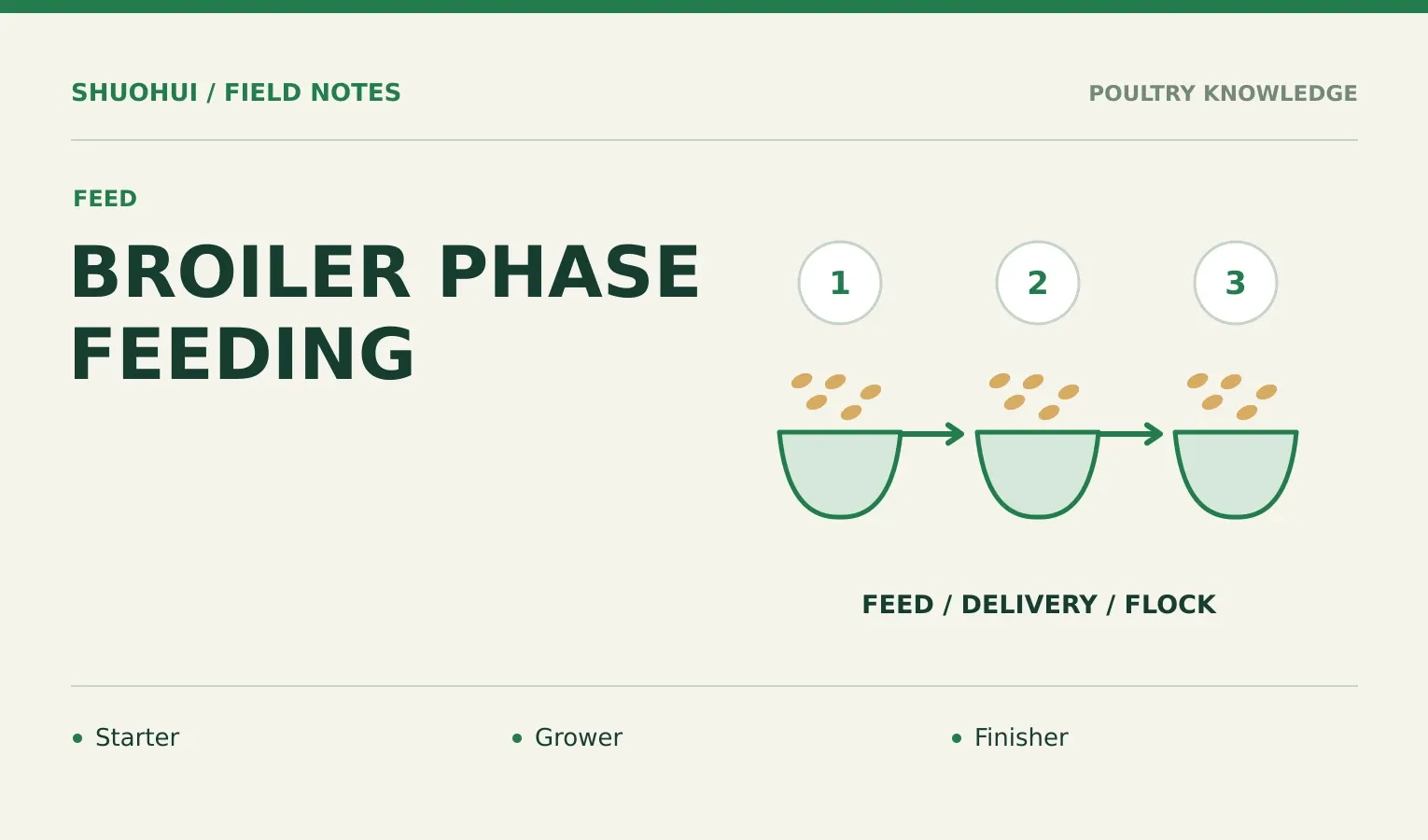
The classic split runs the starter from day-old to 21 days, the grower from 22 to 37 days, and the finisher from 38 days to slaughter. Exact cut-off days flex with strain, target weight, and market, but the shape holds: a short, rich starter, a substantial grower, and a finisher tuned for cheap, efficient weight gain.
- Starter: 0-21 days
- Grower: 22-37 days
- Finisher: 38 days to slaughter
Starter Phase Nutrition (0-21 Days)
The starter is the most nutrient-dense diet of the bird's life. Chicks are building organs, immune systems, and the skeletal frame that will carry a heavy market bird, so protein runs high at 21-22%, and high-specification programs push 22-24%. Energy sits around 3000 kcal/kg. Getting early growth right sets the ceiling for everything that follows.
- Crude protein 21-22%, or 22-24% in high-spec programs
- Energy ~3000 kcal/kg
- Digestible lysine ~1.28% to drive early lean growth
- Early weight is hard to recover if missed
Grower Phase Nutrition (22-37 Days)
In the grower phase the bird is growing fast and eating a lot. Protein eases to 19-20% while energy nudges up to about 3050 kcal/kg to fuel the accelerating gain. This is the longest stretch of active muscle deposition, so amino-acid balance still matters, but the diet begins its shift toward energy.
- Crude protein 19-20%
- Energy ~3050 kcal/kg
- Digestible lysine ~1.15%
- Peak feed intake makes this phase a major cost driver
Finisher Phase Nutrition (38 Days to Slaughter)
The finisher is built for efficient weight gain. Protein comes down to 18-19% and energy rises to 3100-3200 kcal/kg, so the bird converts a dense, high-energy ration into cheap late-stage weight. Because the finishing bird eats the most feed in absolute terms, small efficiency gains here move the whole flock's economics.
- Crude protein 18-19%
- Energy 3100-3200 kcal/kg
- Digestible lysine ~1.02%
- The most feed is consumed here, so efficiency pays off most
The Protein-Down, Energy-Up Logic
The single most important pattern to internalize is the crossing of two curves. Protein as a share of the diet falls from 21-22% to 18-19%; energy rises from ~3000 to 3100-3200 kcal/kg. Young birds are laying down protein-rich tissue and need amino acids; older birds are finishing weight and need calories. Digestible lysine, the reference amino acid, mirrors protein — roughly 1.28% in starter, 1.15% in grower, and 1.02% in finisher.
- Protein: 21-22% → 19-20% → 18-19%
- Energy: ~3000 → ~3050 → 3100-3200 kcal/kg
- Digestible lysine: ~1.28% → ~1.15% → ~1.02%
Reading Feed Conversion Ratio
FCR — kilograms of feed per kilogram of live weight — is the headline efficiency number. A solid commercial flock runs 1.6-1.85. Fast-growing white broilers achieve 1.5-1.8, a Cobb500 flock commonly lands around 1.65, and the very best managed flocks push below 1.6. FCR is a scoreboard for how well genetics, feed, health, and environment line up.
- General good FCR: 1.6-1.85
- Fast-growing white broilers: 1.5-1.8
- Cobb500 typical: ~1.65
- Top flocks: below 1.6
Amino Acids Over Crude Protein
Crude protein is a blunt instrument; what the bird actually uses are digestible amino acids, with lysine as the benchmark. Formulating to digestible lysine — and keeping methionine, threonine, and others in the right ratio to it — lets you meet the bird's true needs, sometimes at lower total crude protein. That trims nitrogen excretion and cost without sacrificing growth.
- Formulate to digestible lysine, not just crude protein
- Keep methionine, threonine and others balanced to lysine
- Lower crude protein with balanced amino acids can cut cost and nitrogen output
Feed Form: Crumble Then Pellet
Physical form matters as much as chemistry. Young chicks get a crumble sized for small beaks, and birds move to pellets as they grow. A good pellet reduces selective feeding and feed waste and improves intake, which flows straight through to daily gain and conversion.
- Crumble for the starter, sized for small chicks
- Pellets for grower and finisher to lift intake and cut waste
- Feed form directly influences daily gain and FCR
NSP Enzymes and Feed Additives
Cereal grains carry non-starch polysaccharides (NSPs) that the bird cannot digest well and that can gum up the gut. Adding NSP-degrading enzymes unlocks trapped energy and nutrients — a worthwhile enzyme program can raise daily gain by roughly 5% and improve FCR. Enzymes let you get more from the same raw materials.
- NSP enzymes can raise daily gain ~5% and improve FCR
- Release energy and nutrients otherwise locked in cereal fiber
- A common lever for squeezing more from existing formulations
Feed Withdrawal Before Slaughter
Before processing, birds go through a planned feed withdrawal. Emptying the gut reduces the risk of gut rupture and carcass contamination on the line and improves food-safety outcomes. Timing is a balance — too short leaves the gut full, too long costs live weight and can weaken the intestine. Follow processor and veterinary guidance for the exact window.
- Feed withdrawal clears the gut before processing
- Lowers contamination risk and improves carcass hygiene
- Time it carefully — too long costs weight; follow processor/vet guidance
Minerals: Calcium and Phosphorus
Broilers need enough mineral for a strong skeleton to carry fast-gained weight, but far less calcium than a laying hen. Diets typically supply calcium around 0.9-1.0% and available phosphorus about 0.45%. Get the ratio right to protect leg health and avoid the lameness that undercuts welfare and yield in heavy birds.
- Calcium ~0.9-1.0%
- Available phosphorus ~0.45%
- Balanced minerals support leg and skeletal strength in heavy birds
Managing the Phase Transitions
The days around each diet change deserve attention. Switching feed too abruptly can upset the gut and cause a short dip in intake, while dragging a phase on too long wastes expensive protein. A brief overlap — blending the outgoing and incoming diet for a few days — smooths the change. The exact timing should follow the flock's actual body weight and the strain's growth curve rather than the calendar alone, because a fast flock may be ready to move earlier than a slow one.
- Avoid abrupt switches that disturb the gut and intake
- Blend diets briefly across the transition where practical
- Time changes to body weight and growth curve, not just the day count
Water: The Feed That Costs Nothing
No feeding program works without water, and broilers drink far more than they eat — commonly around 1.6-2 times their feed intake by weight. Restricted or poor-quality water depresses feed intake first and growth immediately after, so the cleanest ration underperforms if the drinker line lets the flock down. Water quality, temperature, and pressure sit alongside the ration as first-order performance drivers.
- Broilers drink roughly 1.6-2x their feed intake by weight
- Water shortfalls cut feed intake before anything else
- Treat water quality and delivery as part of the feeding program
Turning Targets Into Performance
Numbers on a spec sheet only become performance when feed, genetics, health, and housing pull together. Temperature, stocking density, water quality, and gut health all move FCR as surely as the ration does. Treat every figure here as a typical range that shifts with strain and market, and consult your breed guide or a local nutritionist or vet when you build a program.
- Environment and health shift real-world FCR as much as the diet
- Match the program to your strain, target weight, and market
- Confirm targets against your breed guide and a nutritionist/vet
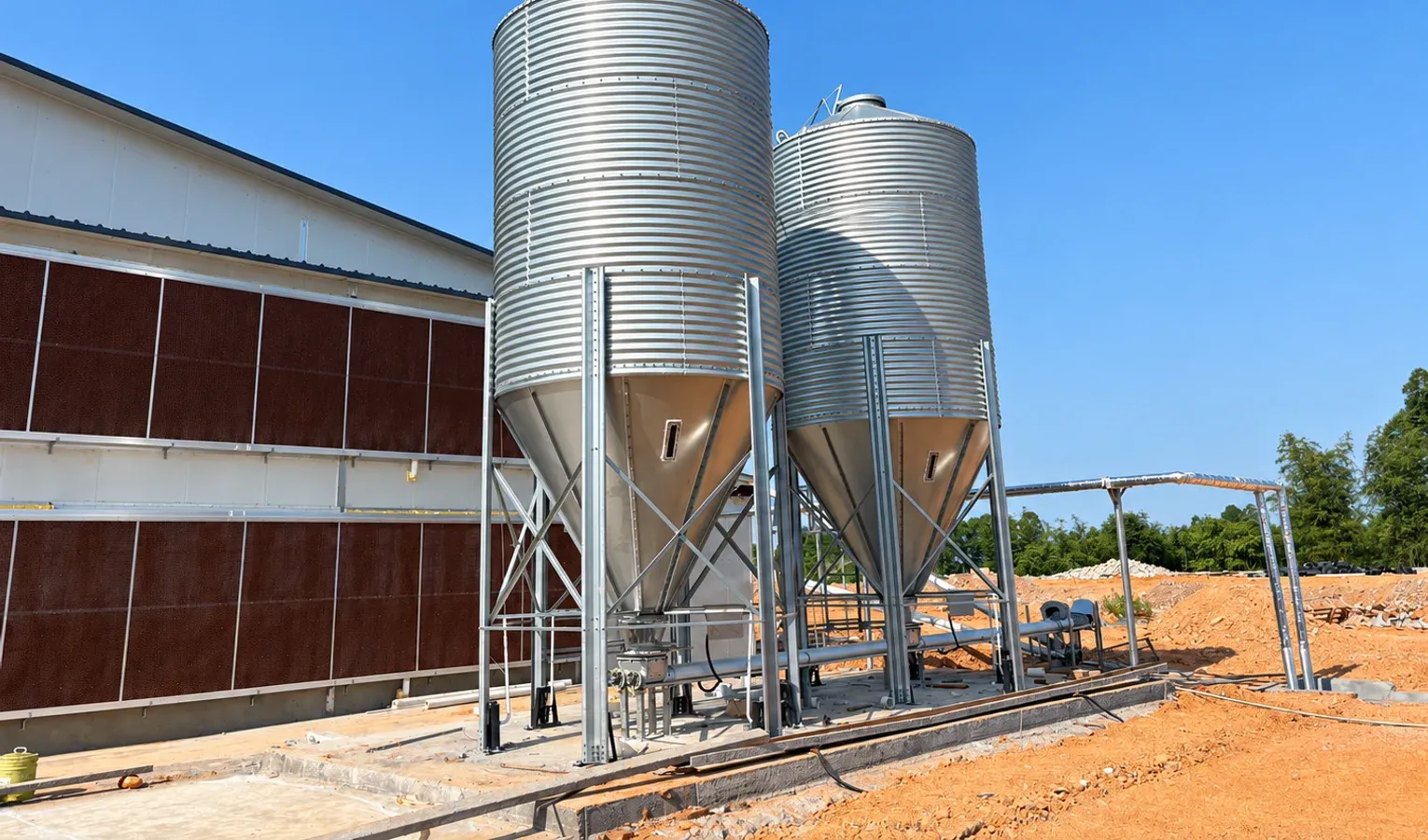
Broiler feeding is a story of timing — rich early, energy-dense late, and clean transitions in between. If you are dialing in a grow-out program and want housing and feeding equipment that deliver each phase's ration accurately and with minimal waste, explore our broiler equipment range or reach out to our team to talk through your setup.
Visual checklist
Related reading
Broiler Feed Conversion: Measuring and Improving FCR
Pellet, Mash or Crumble: Comparing Poultry Feed Forms
Further reading
Use the management guide for the actual breed, age and housing system when selecting flock targets. Review changes with the farm team and the relevant nutrition, health or equipment specialist.