Pull-Out Slat Type Broiler Cage
Specifications
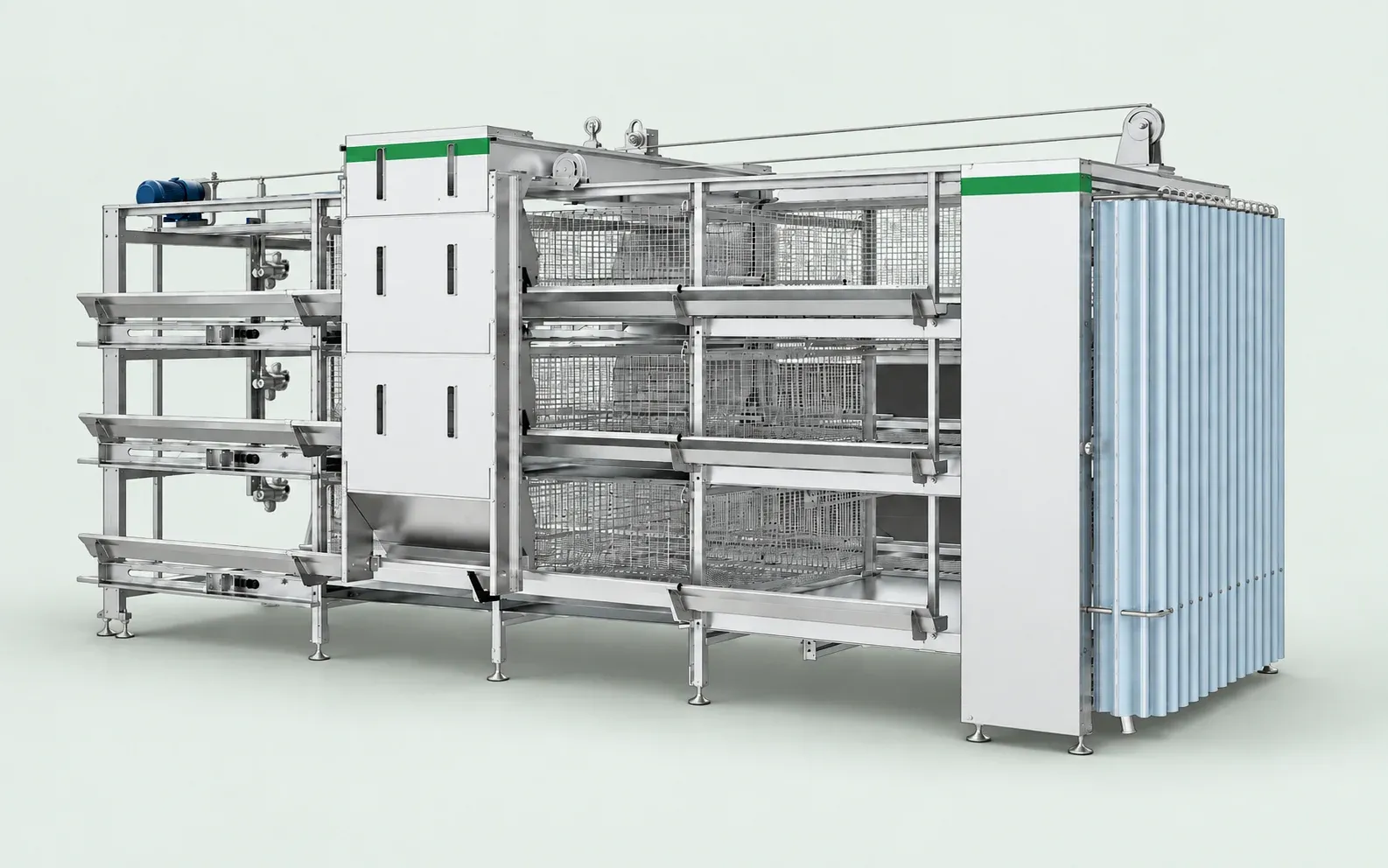
- FloorRemovable plastic slat trays, breast-friendly
- BenefitCuts catching labour and dead-on-arrival losses at harvest
- FeedingAutomatic travelling hopper
- HarvestTrays slide out to present birds for gentle collection
- DrinkingCone-valve nipple line at bird height
- MaterialHot-dip galvanized Q235 low-carbon steel
- StockingRoughly 30 to 38 kg live weight/m² at market
- StructureH-type stacked, pull-out slat floor
- Service life15 to 20 years
- CertificationISO 9001, SONCAP, PVOC
- Manure removalIndependent belt per tier, dried to about 30% moisture
Harvest day is where most broiler operations lose money and welfare points, and the pull-out slat cage is engineered specifically for that moment. Instead of workers reaching into every cell to grab thousands of finished birds, the slat floor slides out and lifts the flock to a collection point, so catching goes faster, gentler and with fewer injuries. It is an H-type stacked cage the rest of the cycle, with all the density that implies.
The catching bottleneck this cage is built to break
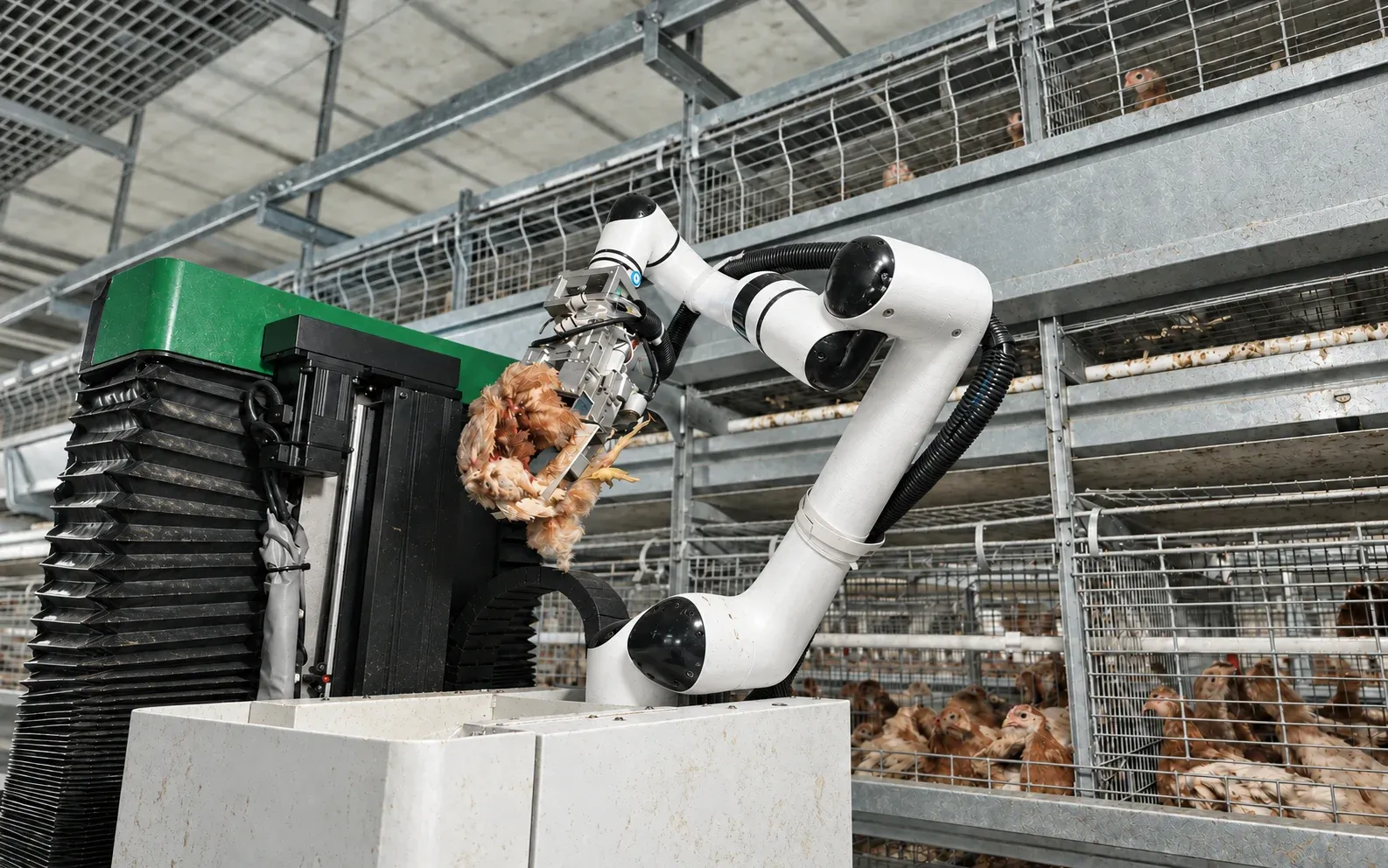
Commercial broiler dead-on-arrival losses average around 0.29% but climb sharply with rough handling, and every bruise downgrades a carcass at the plant. Hand-catching from a conventional cage is the slowest, most stressful job in the cycle — hard on birds, hard on backs, and a real limit on how many houses a crew can turn in a night. The pull-out slat cage attacks exactly this: by presenting birds instead of making crews dig them out, it shortens catching time, cuts the physical grabbing that causes bruising, and lets a smaller crew clear a large house.
How the pull-out slat floor works
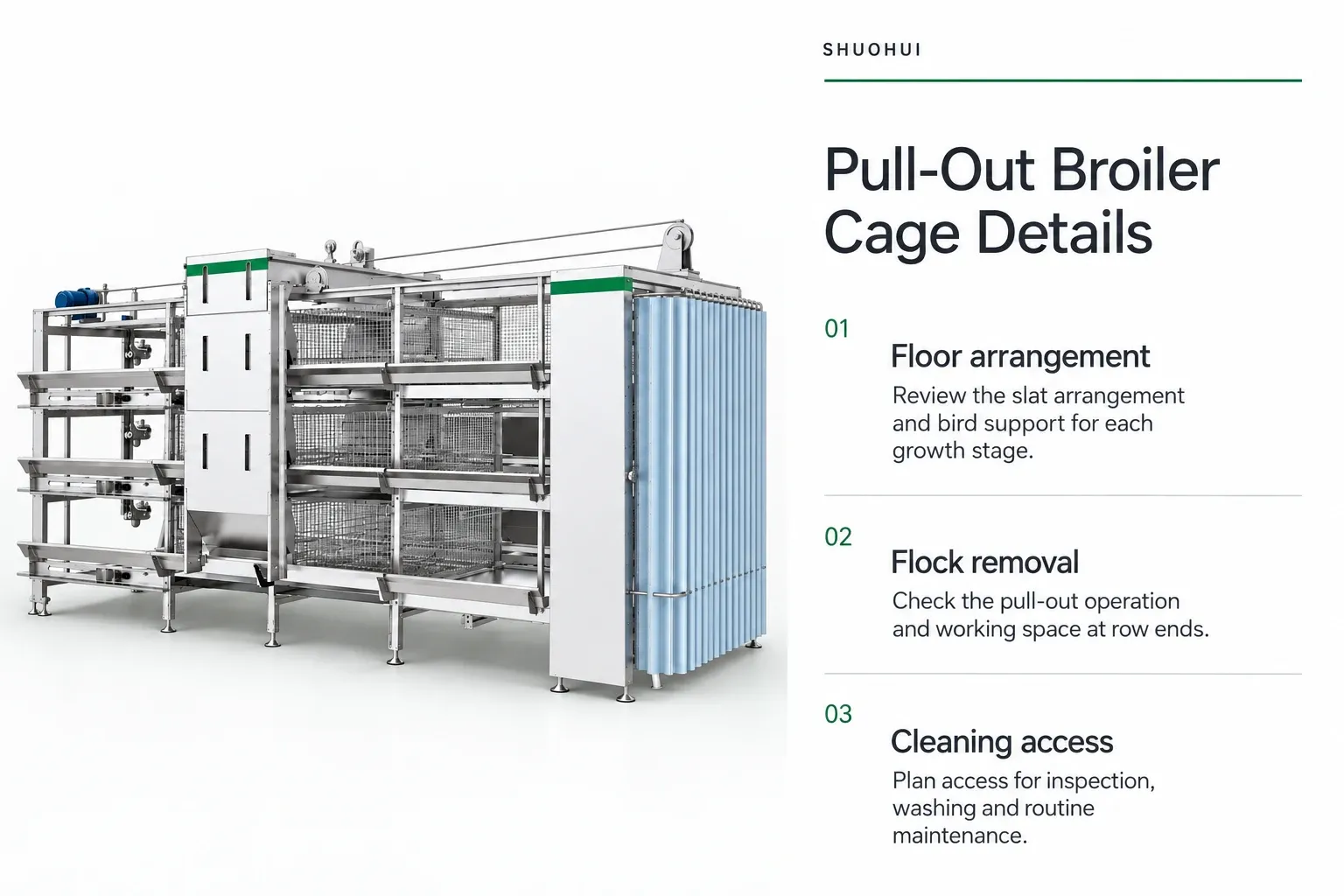
Each tier's floor is a removable plastic slat tray. During the grow-out it functions as a normal cage floor, supporting the birds while droppings pass through to the manure belt below. At harvest the tray slides outward on its rails, moving the birds to the cage front where they can be lifted out calmly, tier by tier. Because the birds travel with the floor rather than being chased around a fixed cage, handling stress and wing or leg damage drop noticeably compared with reaching-in catching.
Pull-Out Broiler Cage Details
Read the selection checklist
H-type stacking with per-tier manure belts
Between hatch and harvest this is a full H-type system, so it delivers stacked density: rows sit directly above one another with an independent manure belt on every tier. Belts run on a schedule and belt airflow dries manure toward 30% moisture, holding ammonia under about 25 ppm — important for broilers, since ammonia over 20 ppm slows growth and hurts FCR. The stacked layout means far more birds per square metre than an A-type, which is why the pull-out slat cage is favoured by larger, land-constrained meat operations.
Bird welfare on a slat floor: footpad and bruising
The slat surface does double duty for welfare. During grow-out its smooth plastic profile and correct gap size protect the breast and footpad of a heavy fast-growing bird, avoiding the lesions that a bare-wire or over-coarse floor causes. At the end it protects the birds again by removing the violent part of catching. Together these address the two points where broiler welfare and carcass grade are most often lost — daily standing comfort and harvest handling.
Pull-out slat vs conveyor-harvest vs A-type
There are three routes to a caged broiler harvest. A plain A-type is cheapest but relies entirely on hand-catching from each tier. A conveyor / chain-type harvesting cage moves birds out on a built-in belt — highest automation, highest cost. The pull-out slat cage sits between them: much gentler and faster than A-type hand-catching, simpler and lower-cost than a full conveyor line. If harvest labour, bruising or DOA is your pain point but a full conveyor system is more than you need, the pull-out slat is the balanced choice.
Labour and DOA math at harvest
The payback lives in the harvest window. Faster tray presentation means fewer crew-hours per house and more houses cleared per night; gentler handling means fewer bruised downgrades and lower DOA on the truck. Add feed-withdrawal discipline — birds off feed more than 6 hours before loading and transport kept under 4 hours both raise mortality — and the pull-out slat cage lets you hit the loading schedule without punishing throughput to do it.
What to check on a pull-out slat cage
Inspect the mechanism, not just the marketing. The slat trays should slide smoothly on real rails without jamming under a full bird load; the plastic should be food-grade and rigid enough not to sag; the manure belt under each tier should be genuine PP. Standard build quality applies — 1.56 mm hot-dip galvanized wire on a Q235 frame, food-grade nipple line, and ISO 9001 / SONCAP / PVOC certification for African and Gulf ports.
Send us your flock size, target market weight and how many birds you need to catch per night, and we will size a pull-out slat layout with the tier count, manure handling and harvest flow to match.
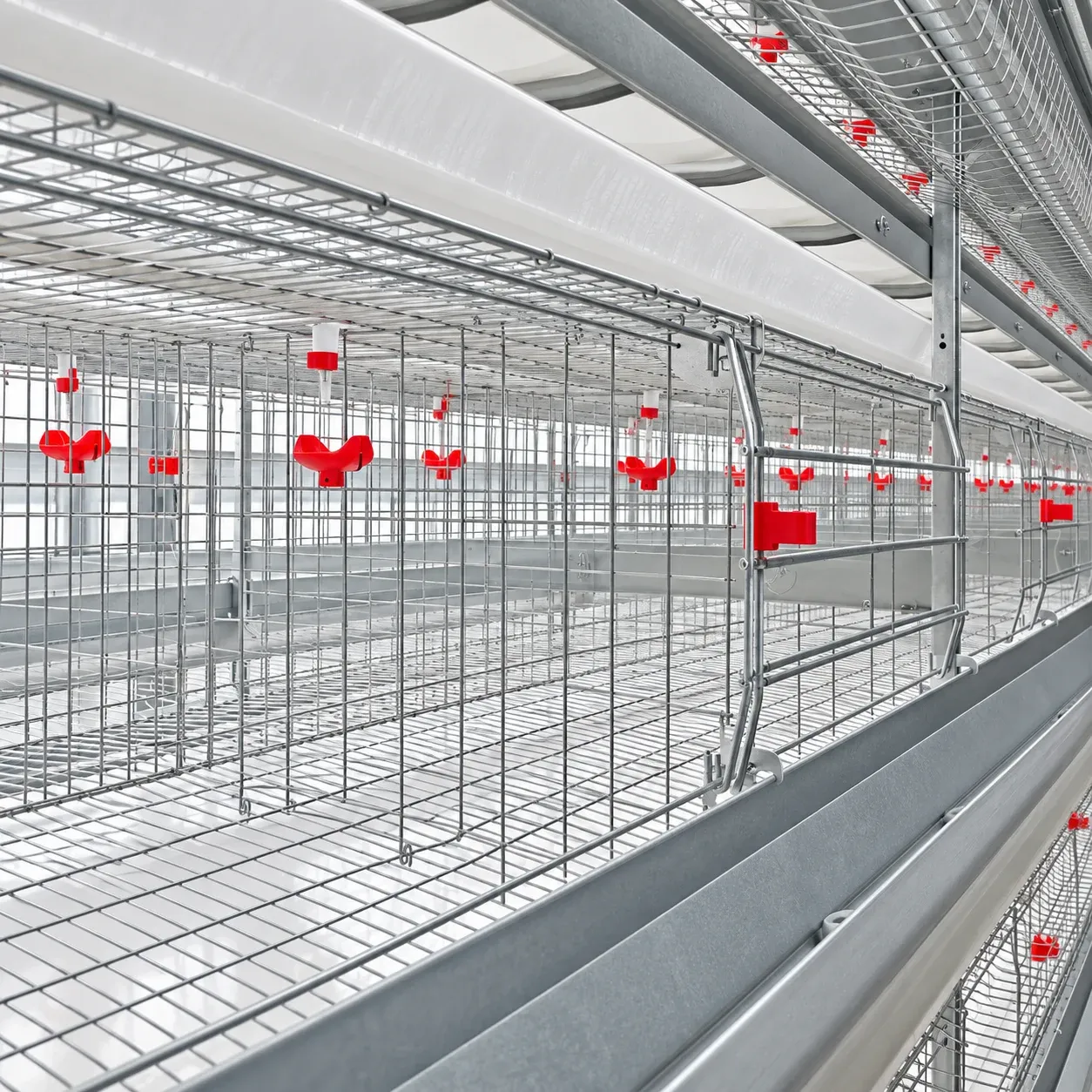
Equipment views & details
ORDER & DELIVERY
Shipping process
- 01
Requirements
Share your bird type, planned capacity, destination and project needs.
- 02
Configuration and order
Confirm the equipment list, drawings, quotation and agreed order terms.
- 03
Production and inspection
Prepare and inspect the equipment against the confirmed configuration.
- 04
Packing and loading
Check the packing list and coordinate protective packing and loading arrangements.
- 05
Transport and dispatch
Arrange shipment and the required documents according to the agreed delivery terms.
- 06
Arrival and handover
Check the delivered packages and equipment, and coordinate the next installation steps.