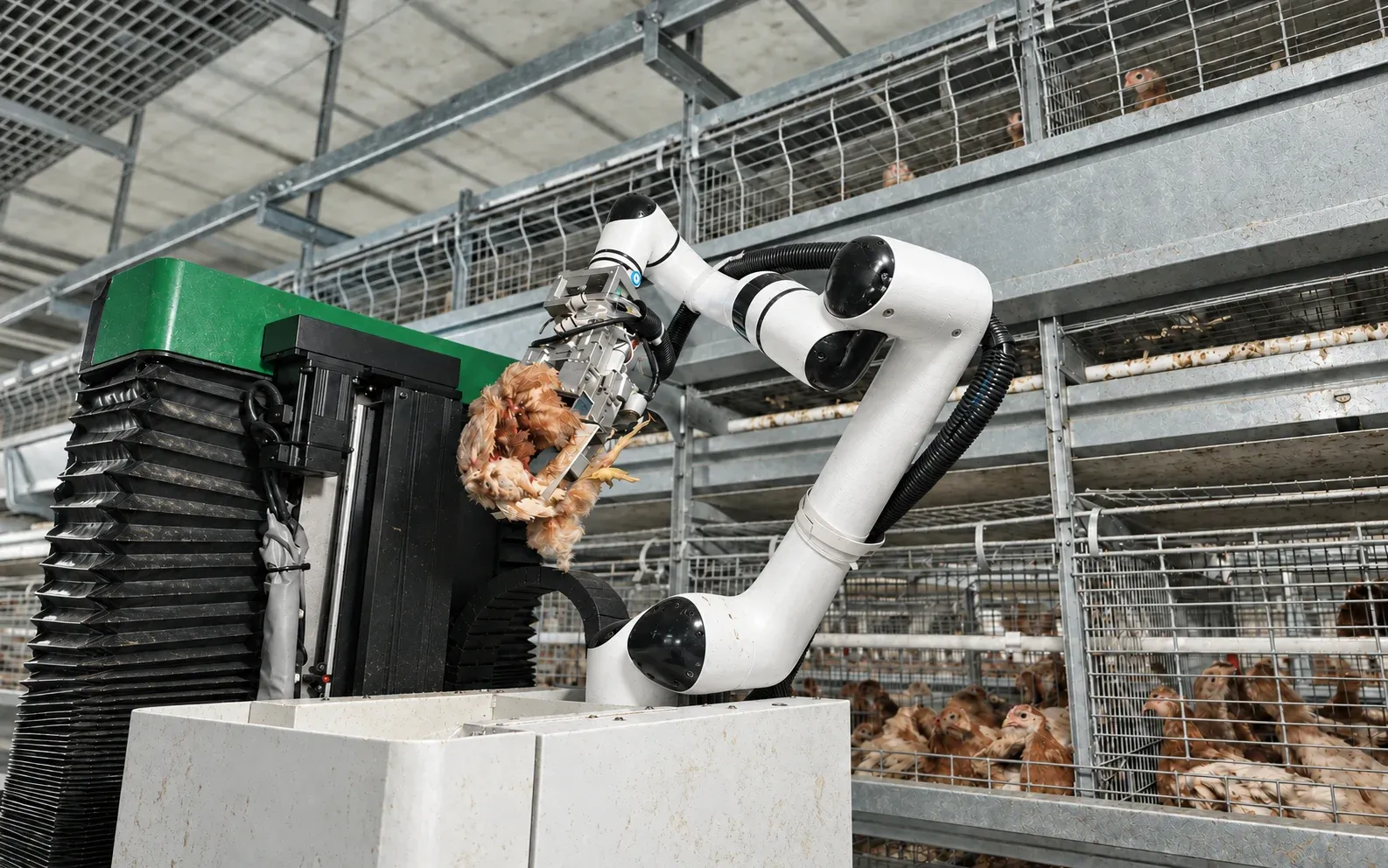
Enriched Colony Layer Cage (Furnished Welfare Cage)
Specifications
- TypeEnriched / furnished colony cage
- FeedingAutomatic travelling hopper
- DrinkingCone-valve nipple line
- MaterialHot-dip galvanized Q235 low-carbon steel
- Feed troughMin 12 cm per hen
- Service life15 to 20 years
- CertificationISO 9001, SONCAP, PVOC
- Space per henMinimum 750 cm² (600 usable + 150 nest) to EU 1999/74/EC
- Wire diameter1.56 mm hot-dip galvanized
- Egg collectionCentral automatic belt, roll-out to nest front
- Birds per colony20 to 60, by model
- Welfare fittingsNest curtain, perch (min 15 cm/hen), scratch/dust pad, claw-shortening strip
An enriched colony cage exists because of regulation, not just engineering: conventional battery cages were banned across the EU from 2012 under Directive 1999/74/EC, and the furnished cage is the compliant middle path between a bare cage and full cage-free. It keeps the hygiene, egg quality and labour efficiency of a caged system while adding the fittings that let hens perch, nest, scratch and dust-bathe.
The welfare features that make a cage "enriched"
Four fittings turn a cage into a colony. A nest area with a soft curtain gives hens a private, dim place to lay, so eggs roll out clean instead of being trodden in the open cage. A perch — at least 15 cm per hen — lets birds roost off the wire, which strengthens legs and reduces stress. A scratch and dust pad, usually an abrasive mat fed with a little feed, satisfies foraging behaviour. And a claw-shortening strip at the trough keeps nails worn down. None of these appear on a conventional battery cage, and all of them are what an EU or premium-market audit looks for.
Space math: 750 cm² and why it's the legal floor
The number that governs the whole design is 750 cm² per hen — of which 600 cm² must be usable and 150 cm² is the nest. That is nearly double the 400 to 450 cm² a conventional cage allowed, which is why a furnished cage holds fewer birds in the same steel and why hen density, not just fittings, is part of compliance. The trough must give at least 12 cm of feeder per hen and the drinker must be within reach of every bird. When you compare colony models, check that the quoted bird count actually leaves each hen her 750 cm² — an over-stuffed "enriched" cage fails audit no matter how many perches it has.
Enriched Colony Housing
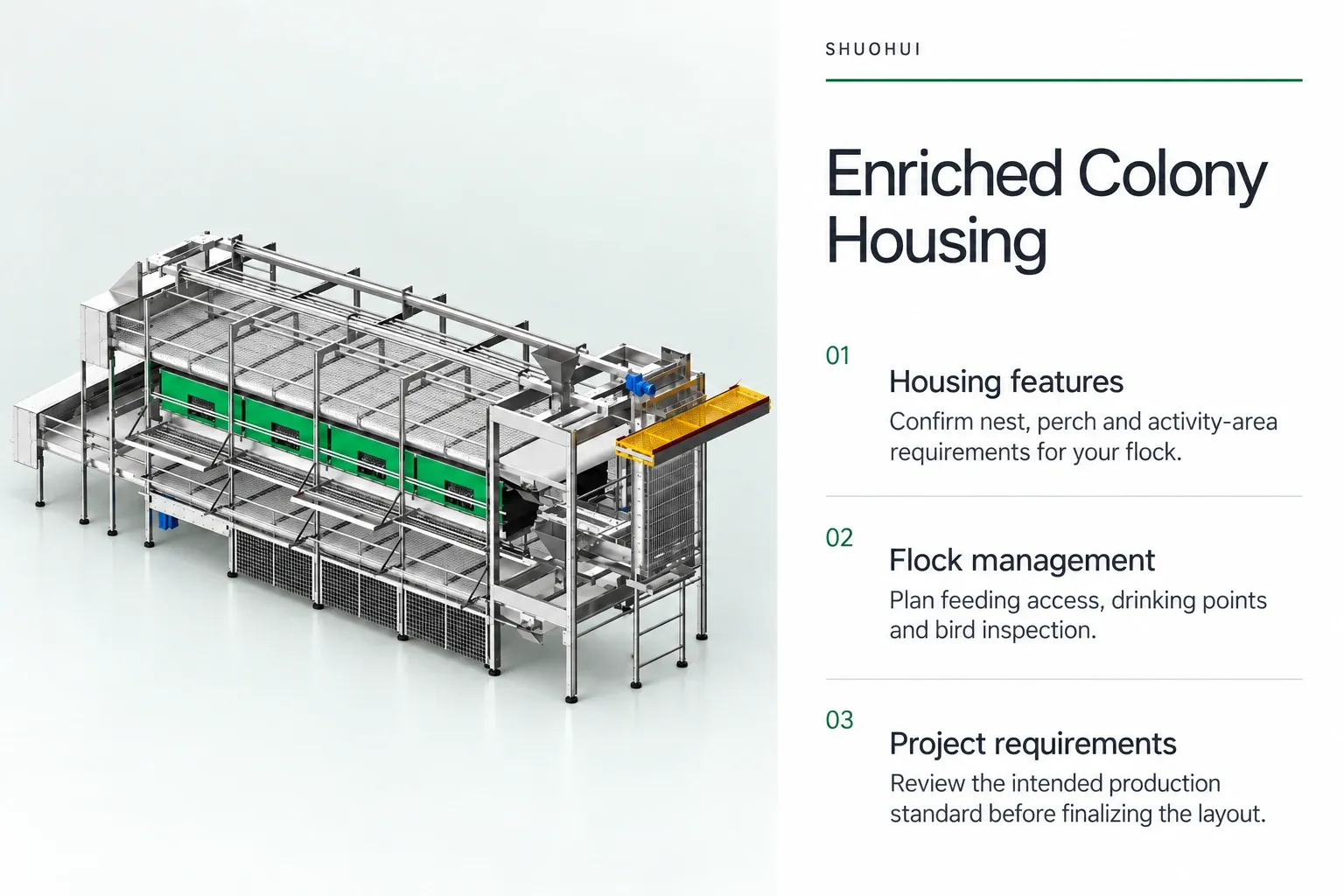
Read the selection checklist
Colony sizes from 20 to 60 hens
Furnished cages are grouped as colonies rather than tiny cells, and colony size is a real choice. Smaller colonies of 20 to 30 hens keep social groups stable and are easier to inspect; larger colonies of 40 to 60 hens raise stocking efficiency and lower cost per bird but need careful nest and perch placement so no hen is crowded out. The right size depends on your market's welfare label and how many birds you plan to run — pick the colony model first, then lay out the house around it.
Enriched cage vs conventional battery vs cage-free
The enriched colony sits deliberately between two extremes. Against a conventional battery cage it gives far more space and welfare fittings, at the cost of fewer birds per house and higher steel per hen. Against a cage-free aviary it keeps hens contained — cleaner eggs, lower ammonia exposure, easier disease control and lower labour — but delivers less freedom of movement and does not qualify for a "cage-free" egg label. If your buyers demand welfare compliance but you want to keep caged-system hygiene and automation, the furnished cage is the target.
Which export markets require furnished cages
Furnished or better is mandatory for eggs sold into the EU, and enriched-colony systems are used in parts of the United States where UEP-style space standards apply. Middle-East and African supermarket chains supplying Western buyers increasingly ask for the same. If you are exporting eggs — or building where legislation is trending toward welfare — specifying furnished cages now avoids a forced rebuild later. Confirm which directive or retailer standard your buyer cites, because space and fitting rules differ slightly between them.
Integrating feed, water and egg belts into a colony
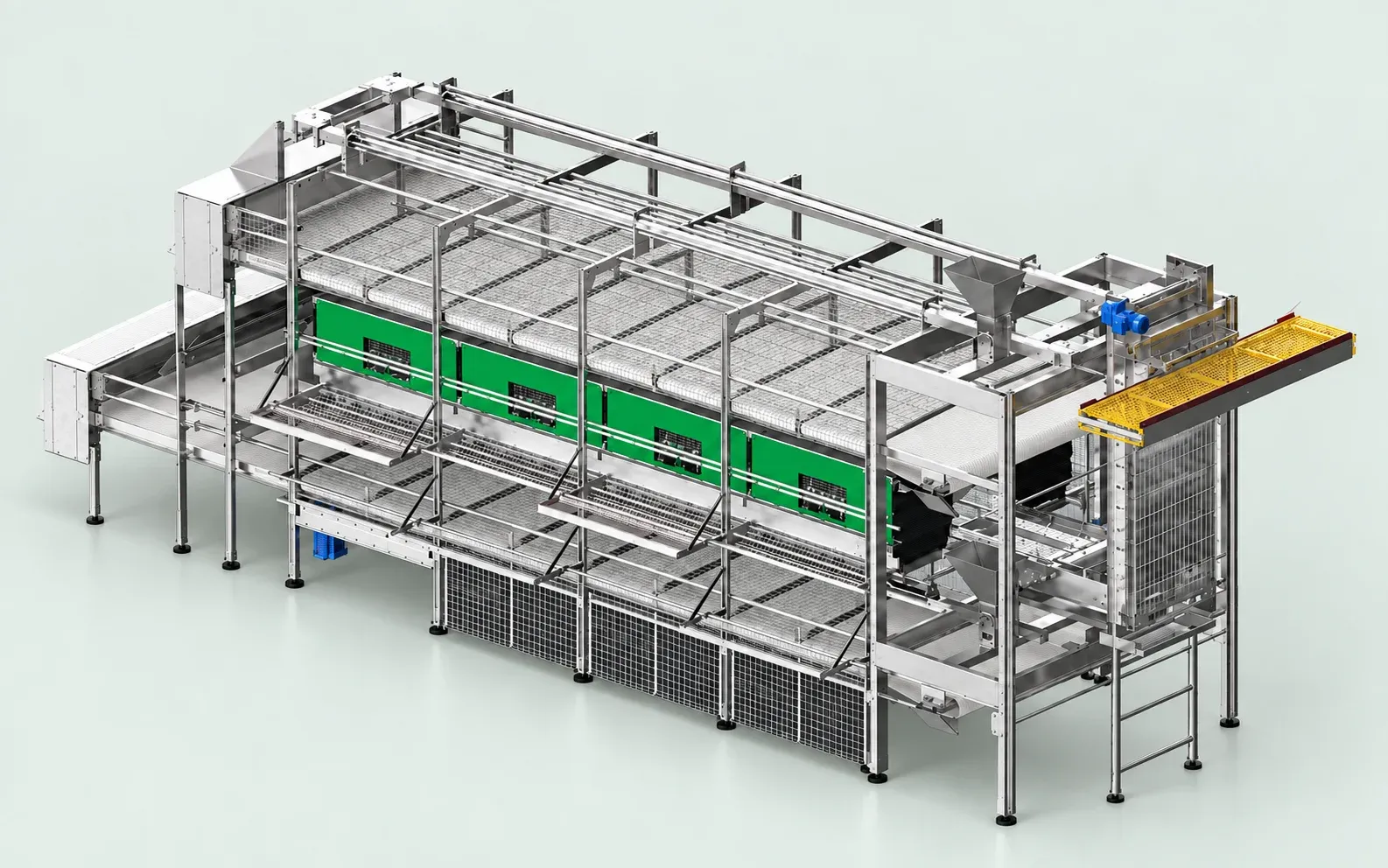
A colony cage still runs on the same automation as any modern layer house. A travelling hopper feeds the full-width trough, a cone-valve nipple line waters every hen, and a central egg belt collects the eggs that roll out of the nest fronts at 0.2 to 1% breakage. The key integration point is the nest: the egg belt must sit right at the nest lip so eggs transfer gently the instant they roll out, which is what protects the clean-egg advantage furnished cages are prized for.
Specifying a colony cage that passes audit
To buy a cage that will actually clear a welfare inspection, hold four things: verified 750 cm² per hen at the quoted stocking, a genuine nest with curtain, perch length of at least 15 cm per hen, and a scratch pad plus claw strip on every colony. Build quality is the same premium standard — 1.56 mm hot-dip galvanized wire, Q235 frame, food-grade drinker — with ISO 9001, SONCAP and PVOC paperwork on file.
Send us the welfare standard your buyer requires and your target flock size, and we will match a colony model and stocking plan that meets the space rule while keeping your cost per hen as low as compliance allows.
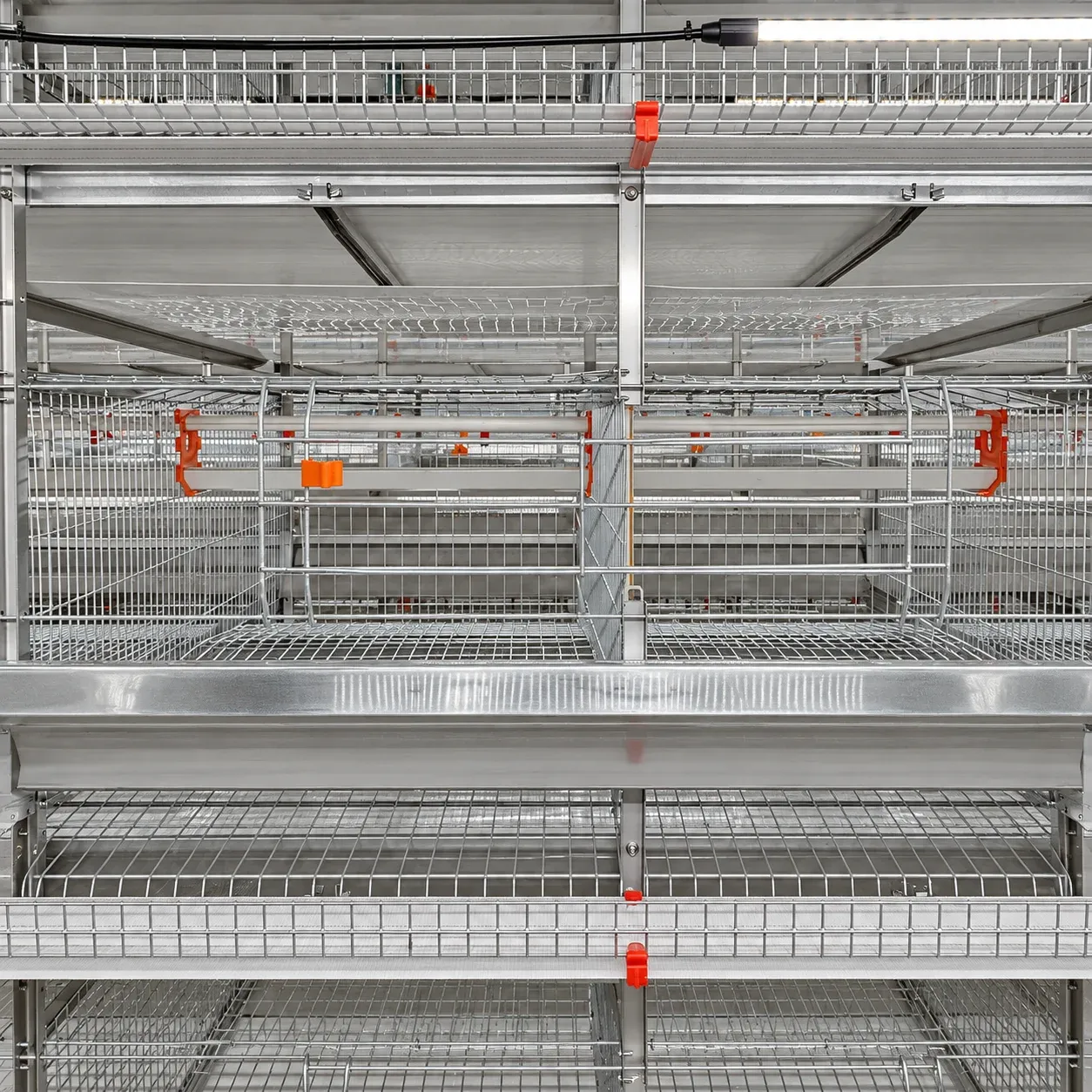
Equipment views & details
ORDER & DELIVERY
Shipping process
- 01
Requirements
Share your bird type, planned capacity, destination and project needs.
- 02
Configuration and order
Confirm the equipment list, drawings, quotation and agreed order terms.
- 03
Production and inspection
Prepare and inspect the equipment against the confirmed configuration.
- 04
Packing and loading
Check the packing list and coordinate protective packing and loading arrangements.
- 05
Transport and dispatch
Arrange shipment and the required documents according to the agreed delivery terms.
- 06
Arrival and handover
Check the delivered packages and equipment, and coordinate the next installation steps.