Broiler Chicken Cage
Specifications
- FloorPlastic-coated or fine mesh, breast and footpad friendly
- Tiers3 to 4 (A-type) up to multi-tier stacked (H-type)
- FeedingAutomatic travelling hopper
- LayoutsA-type stepped, H-type stacked, pull-out slat
- PurposeCage housing for meat chickens, chick to market
- DrinkingCone-valve nipple line, height-adjustable
- MaterialHot-dip galvanized Q235 low-carbon steel
- StockingAbout 8 to 10 birds/m² and 30 to 38 kg live weight/m² at market
- Service life15 to 20 years
- CertificationISO 9001, SONCAP, PVOC
- Wire diameter1.56 mm hot-dip galvanized
- Manure removalBelt or scraper, ammonia held under about 25 ppm
Deciding how to house meat birds is really two decisions stacked together: cage or floor, and if cage, which cage layout. This page is the map for that choice. A broiler cage lifts birds off their own litter, multiplies house capacity, and generally improves feed conversion and disease control — but the right configuration depends on your flock size, building, labour and harvest plan.
Cage rearing vs floor rearing for meat birds
Floor rearing keeps broilers on litter for the whole cycle. It is cheap to set up but caps density and drives litter-borne problems — footpad lesions, breast blisters, coccidiosis — because birds sit in their own droppings. Caging breaks that: birds stand on mesh, manure falls away, and you stack 3 to 4 tiers or more instead of spreading across a floor. Farms typically see cleaner feet, lower medication use, and often a slightly better FCR because birds move less and stay in a tighter thermal zone. The costs are higher capital outlay and a harder catching job at harvest.
The three broiler cage layouts you'll be quoted
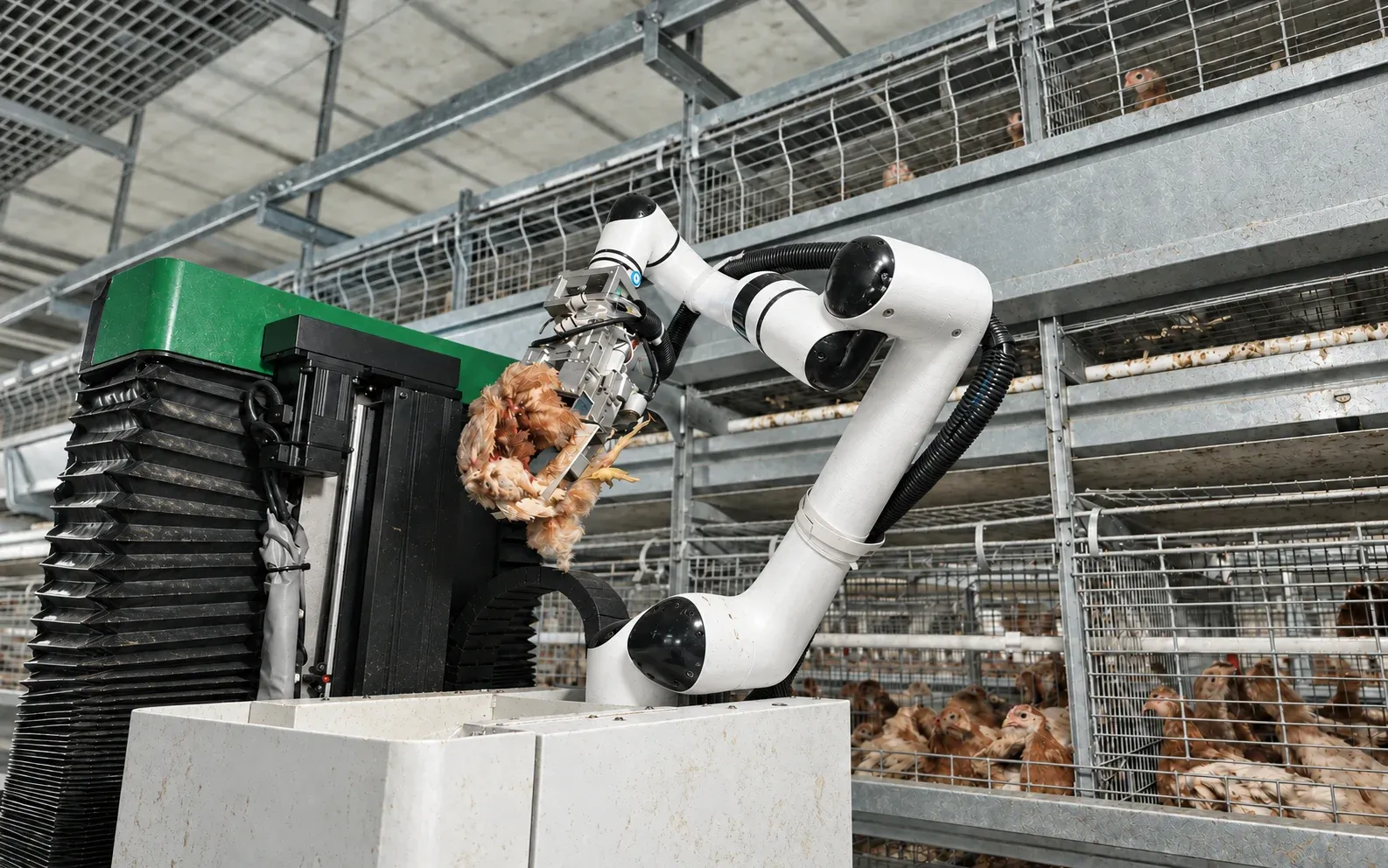
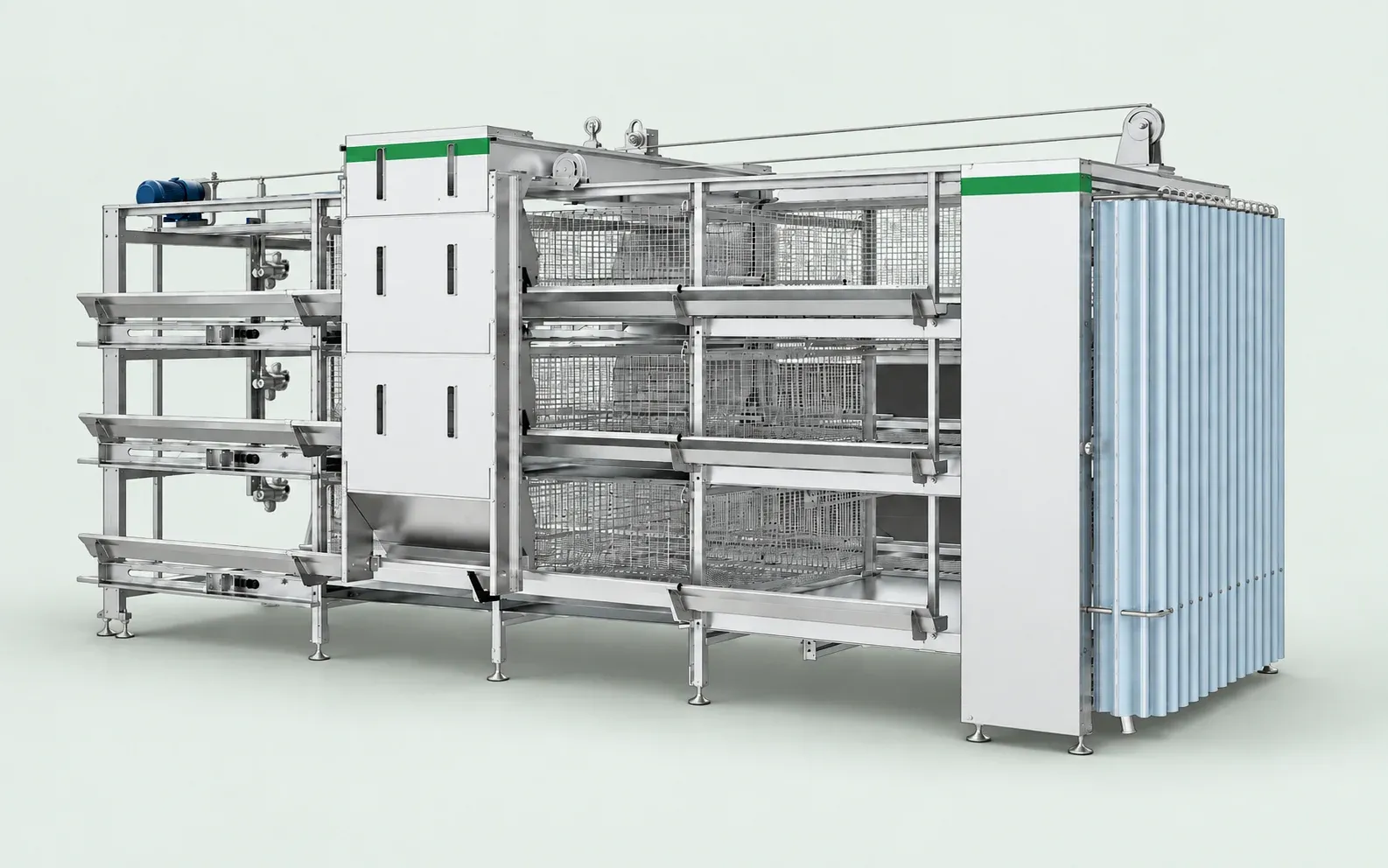
Suppliers will offer three geometries. A-type steps the tiers outward so manure drops into an open channel — cheapest, lowest building, simplest, but relies on hand-catching. H-type stacks tiers vertically with a manure belt on every level — highest density and full automation, best where land is tight. Pull-out slat is an H-type whose floor trays slide out at harvest to present birds for gentle collection, aimed squarely at cutting catching labour and dead-on-arrival losses. Pick the layout before you compare prices, because each is a different machine.
Broiler Cage Selection
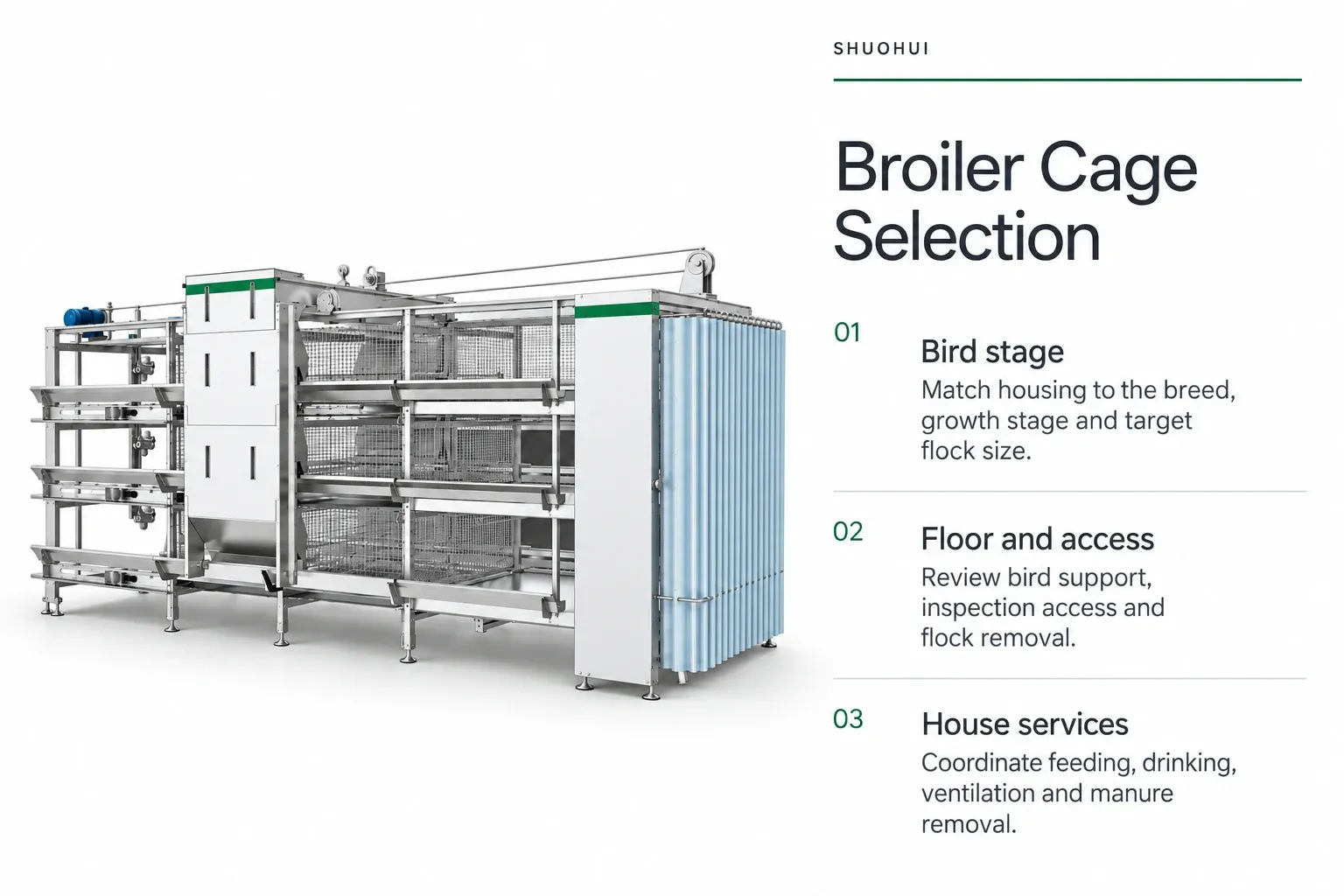
Read the selection checklist
Density and live-weight per square metre
Broiler cages are sized by finished live weight, not chick count, because a bird triples in mass over the cycle. Plan for roughly 8 to 10 birds/m² and about 30 to 38 kg of live weight per square metre of cage floor at market. Crowd past that and intake, uniformity and FCR slip; leave slack and you waste capacity you paid for. A 2.8 kg bird for a whole-carcass market needs more room than a 1.8 kg bird for portioning — so set stocking from the target weight your buyer wants.
Floor design is what protects your grade
The floor is the make-or-break detail on any broiler cage. A heavy, fast-growing bird stands on it all day, so the surface must support the breast and footpad while letting droppings through. Good cages use plastic-coated or fine galvanized mesh with a correct gap; poor ones use coarse or bare wire that burns footpads and marks breasts, and every one of those defects is a downgrade at the plant. Whatever layout you choose, insist on seeing the actual floor sample — this single component decides how much of your flock grades A.
Choosing tiers, drive and harvest method
Three variables set the price and the labour profile. Tiers: 3 to 4 for a lower building or moderate flock, more for a tall automated house. Drive / automation: manual feeding and catching at the low end, full travelling-hopper feeding and belt manure removal at the high end. Harvest method: hand-catching (A-type), tray presentation (pull-out slat), or conveyor (chain-type). Match these to your real constraints — building height, labour cost and how many birds you must catch per night — rather than buying the most or least automated option by default.
Equipment that has to come with the cage
A broiler cage is only part of a working house. Budget from the start for a travelling hopper feeder, a nipple drinking line set to bird height and raised as they grow, a belt or scraper manure system that holds ammonia under about 25 ppm, and integration with brooding heat, tunnel fans and a cooling pad for first-week warmth and hot-weather growth. A cage price that excludes these is not a house price — confirm exactly what a quote covers before comparing two of them.
A buyer's shortlist for broiler cages
Before you commit, check five things: the floor mesh is plastic-coated and breast-friendly; wire is 1.56 mm hot-dip galvanized on a Q235 frame, hot-dipped after welding; the automation level matches your labour reality; the harvest method fits your catching capacity; and the supplier holds ISO 9001, SONCAP and PVOC certification for your port. Get all five right and the cage lasts 15 to 20 years.
Tell us your flock size per cycle, target market weight and building dimensions, and we will recommend the layout — A-type, H-type or pull-out slat — and a complete equipment list to match your operation.
ORDER & DELIVERY
Shipping process
- 01
Requirements
Share your bird type, planned capacity, destination and project needs.
- 02
Configuration and order
Confirm the equipment list, drawings, quotation and agreed order terms.
- 03
Production and inspection
Prepare and inspect the equipment against the confirmed configuration.
- 04
Packing and loading
Check the packing list and coordinate protective packing and loading arrangements.
- 05
Transport and dispatch
Arrange shipment and the required documents according to the agreed delivery terms.
- 06
Arrival and handover
Check the delivered packages and equipment, and coordinate the next installation steps.