Automatic Feeding System (Travelling Hopper)
Specifications
- FitA-type and H-type cage houses
- TypeTravelling hopper (gantry) feeder for cage rows
- Power380 V / 220 V, 50 / 60 Hz
- LabourOne operator per about 40,000 birds
- ControlProgrammable feeding times, adjustable pass count
- Feed pipeGalvanized, Φ45 mm
- Drive motor0.75 / 1.1 / 1.5 kW options
- Feed saving15-20% versus hand feeding
- Travel speedAbout 8-9 m/min per pass
- CertificationISO 9001, SONCAP, PVOC
- Hopper capacityAround 60 kg per hopper, 2 hoppers per tier
- Distribution evennessOver 95%
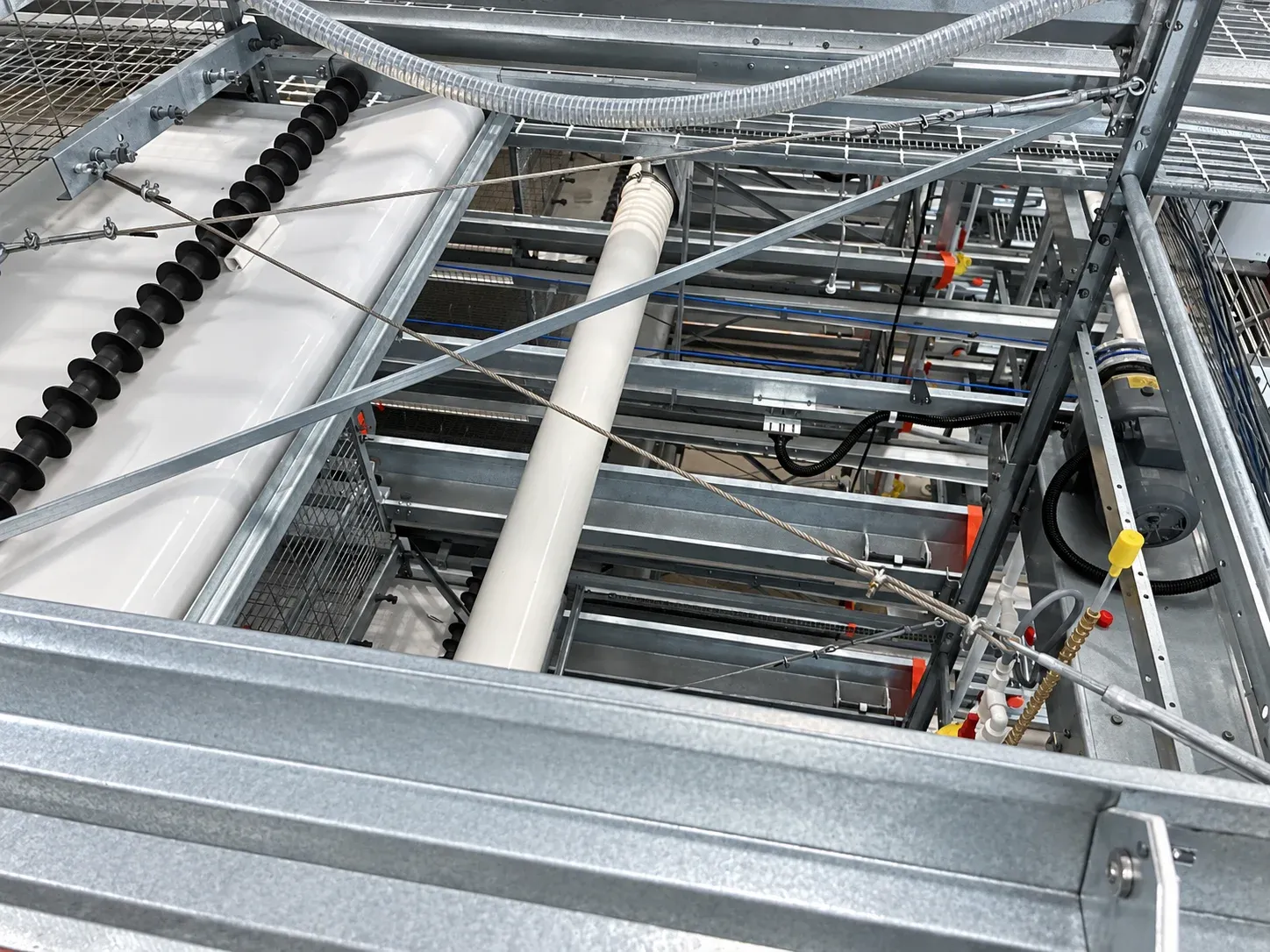
A travelling hopper feeder is a motorized trolley that rides on rails above each cage tier, carrying feed with it and metering a measured stream into the trough as it passes. Unlike a chain or auger that drags feed along a fixed line, the hopper brings the ration to the birds, which keeps feed clean, makes portion control exact, and lets you feed the whole house on a timer. For A-type and H-type layer and broiler cages, it is the standard feeding method, and getting its settings right is one of the cheapest ways to protect your single biggest cost.
How the trolley meters feed
The hopper is filled at one end of the row, then driven along the tier by a small gearmotor. Outlets in the base of the hopper release feed into the trough at a rate set by the trolley's speed and the outlet opening. Because the machine dispenses a fixed amount per pass, you control intake by the number of passes per day rather than by guesswork at the trough. A typical trolley travels at roughly 8-9 m/min, so even a long house is fed in minutes, and the plug-disc lifting mechanism can be adjusted to keep the outlet clear of the feed already in the trough.
Reading the drive and hopper specs
The numbers that matter on a quotation are the drive motor, hopper volume and pipe size. Drive motors are commonly offered in 0.75, 1.1 and 1.5 kW ratings, sized to the length and load of the row; a longer, fuller house needs the larger motor to travel without straining. Hopper capacity sits around 60 kg per hopper, with two hoppers per tier on many layouts so a single fill covers a full pass. The galvanized feed pipe that refills the hopper is usually Φ45 mm. Power is 380 V or 220 V at 50 or 60 Hz, so confirm your grid before ordering.
Where the 15-20% feed saving comes from
The headline 15-20% feed saving over hand feeding is not one big effect but several small ones stacking up. Mechanical metering delivers a precise portion instead of a heaped scoop; the trolley can feed little and often, so birds face fresh feed several times a day; and correct trough geometry keeps feed where birds peck rather than rake. As a rule, each fill should leave feed no deeper than one-third of the trough, delivered 3 to 4 times a day and cleared in about 20 minutes, with the trough lip about 3 cm above the birds' backs and an inward edge to catch billed feed.
Travelling hopper versus chain and auger-pan
Each delivery type has a home. A chain feeder spreads feed evenly along an open floor trough and suits breeder and floor houses where birds line up shoulder to shoulder. An auger-and-pan system hangs pans wherever the tube runs and wins where layout is irregular. The travelling hopper's advantage is specific to caged birds: it carries feed to each tier's trough, keeps the ration clean on the way, and makes feed restriction simple because every pass delivers a set amount. Distribution evenness stays above 95%, and one operator can run feeding for as many as 40,000 birds.
The two weaknesses to design around
Honesty sells better than a spec sheet that hides trade-offs. First, damp feed can clog the metering outlets, so feed quality and in-house humidity matter more with a hopper than with an open chain; keep the ration dry enough to flow. Second, because the trolley depends on a powered pass along the rails, feeding by hand during an outage is awkward, so reliable power and a backup arrangement belong in the plan from day one. Neither is a deal-breaker, but both are worth engineering around rather than discovering later.
Matching the feeder to your cage rows
Specify the feeder to the house, not the other way round: confirm row length and tier count so the motor and pass timing are sized correctly, match voltage and frequency to your supply, and decide how many daily passes your birds' stage needs. If you would like help pairing a travelling hopper to your A-type or H-type cage layout, or matching it with the drinking and manure lines already in the row, talk with our team and we will work the numbers for your house.
Equipment views & details
ORDER & DELIVERY
Shipping process
- 01
Requirements
Share your bird type, planned capacity, destination and project needs.
- 02
Configuration and order
Confirm the equipment list, drawings, quotation and agreed order terms.
- 03
Production and inspection
Prepare and inspect the equipment against the confirmed configuration.
- 04
Packing and loading
Check the packing list and coordinate protective packing and loading arrangements.
- 05
Transport and dispatch
Arrange shipment and the required documents according to the agreed delivery terms.
- 06
Arrival and handover
Check the delivered packages and equipment, and coordinate the next installation steps.